The year was 1955 and Chief Obafemi Awolowo stood before a crowd of eager parents and children in Ibadan. In his hands, he held the enrolment form of his eldest son. The form was not for the elite missionary school where the wealthy sent their children, but for the nearest public school. This symbolic act would herald one of the most transformative events in modern African history: the famous Awolowo’s free education scheme.
“I do not want the children of my drivers to become drivers to my own children, nor the children of my cooks to become cooks to my own children. Instead, I want free and equal access to education for all,” Awolowo declared. These words would foretell a vision that would reshape an entire generation.
By Joshua I. Mokwuah | August 14, 2026
1920
The idea for Awolowo’s educational revolution sprouted from the soil of a rather traumatic personal experience. When young Obafemi was just twelve years old in 1920, his father died, shattering the family’s financial stability. Following the tragedy, he was forced to withdraw from primary school.
The pain of having his education interrupted burned deep in his soul. He would later reflect on this experience in the Daily Times newspaper:
“By the time I was twelve, I had come to realize that it was of prime importance to be educated. And I embarked upon a set policy of doing hard physical work in order to earn enough to pay my school fees. The importance of education was among the first impressions of life I can remember.”
This traumatic event and the impression it made on the boy’s mind, would become the driving force behind one of Africa’s most ambitious educational programs.
1952
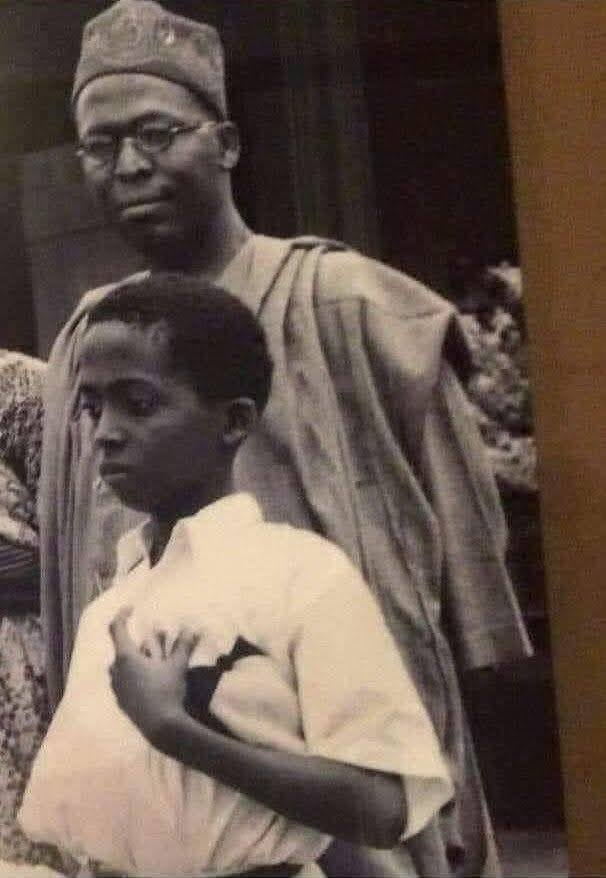
By 1952, Awolowo had risen to become the Head of Government Business and Minister of Local Government for Western Nigeria. The timing was providential. Nigeria was transitioning from colonial rule to independence, and the 1951 Macpherson Constitution had empowered regional governments to make laws regarding education. This constitutional provision became the legal foundation upon which Awolowo would build his educational empire.
Leading the Action Group Party, Awolowo won the first election to the Western House of Assembly in 1952. In his inaugural budget speech, he articulated a philosophy that would guide his administration. In his words, “as far as possible, expenditure on services which tend to the welfare and health and education of the people should be increased at the expense of any expenditure that does not answer to the same test.”
This would form his blueprint for the scheme.
1952
In July 1952, Chief S.O. Awokoya, the Minister of Education for the Western Region, presented what would become known as ‘Awokoya’s Proposals.’ The Proposals were a comprehensive plan calling for Universal Primary Education throughout the Western Region by January 1955.
The proposal was revolutionary in its scope. It advocated free, universal and compulsory education for all children. The scheme would be supported by massive teacher-training programs, expanded secondary schools and the introduction of technical education.
At the time, the Western Region comprised eight provinces that included Abeokuta, Benin, Lagos, Delta, Ibadan, Ijebu, Ondo and Oyo. These would become the testing ground for what education historian Babs Fafunwa would later describe as “the boldest and perhaps the most unprecedented educational scheme in Africa South of the Sahara.”
1955
The Free Universal Primary Education scheme was formally launched on January 17, 1955. The impact was nothing short of spectacular. In 1954, before the launch, 456,600 pupils attended primary schools in Western Nigeria. When the scheme began in January 1955, an astounding 811,432 children enrolled. This was an increase of 354,832 students in a single year and a jump from 35% to 63% of the 5-14 age group.
The numbers told a story of pent-up demand for education that had been constrained only by economic barriers. By 1958, over one million children were enrolled in primary schools across the region.
1959
The scheme triggered a massive expansion in educational infrastructure. Primary schools mushroomed from 3,550 in 1952 to 6,670 by 1958. But Awolowo’s vision extended beyond primary education. Secondary modern schools increased from 9 in 1954 to 533 by 1960. Grammar schools also grew from 59 to 167 in the same period. Teacher training institutions expanded dramatically to meet the unprecedented demand for qualified educators.
This expansion wasn’t limited to basic education. Awolowo established the University of Ile-Ife, now Obafemi Awolowo University. He awarded over 200 tertiary education scholarships annually, a number that rose to 1,200 by 1959. With this, he ensured that the brightest minds had financial pathways to higher education regardless of their economic background.
Besides rhetoric, Awolowo’s commitment to education was reflected in unprecedented budgetary allocations. Between 1954 and 1966, education consumed the largest share of the Western Region’s recurrent budget, varying between 28.9% and 41.2% of total expenditure.
In the 1958-59 financial year alone, 41.2% of the entire regional budget was devoted to education. This was one of the highest proportional expenditures on education in the world at that time. The lion’s share went to primary education, which consumed between 52% and 84% of all educational grants during this period.
1966
Perhaps the most profound impact of the free education scheme was its effect on gender equality in education. Before 1955, the ratio of boys to girls in primary school was 5:1. Cultural attitudes dictated that girls belonged in the kitchen and making investment in their education was seen as wasteful. The free education policy changed this dramatically.
By 1955, the ratio had improved to 5:2. The number of girls in school would more than double between 1954 and 1955. As one contemporary observer noted, parents who didn’t have to pay school fees felt they had “nothing to lose by sending their female children to school.”
By 1966, almost two out of five primary school pupils were girls. This catalyzed a revolutionary shift in social attitudes toward female education in Western Nigeria.
Answering the Critics
However, Awolowo’s free education scheme wasn’t without its critics and challenges. The rapid expansion led to serious problems that would plague the system throughout its existence. Teacher shortages became acute as the demand for qualified educators far outstripped supply. Many unqualified teachers were pressed into service to meet the overwhelming demand, which ultimately resulted in lower educational standards.
The scheme also suffered from high dropout rates, particularly in rural areas. Schools in villages with populations up to 700 experienced wastage rates as high as 84%. The automatic promotion policy, designed to keep children in school, inadvertently contributed to decline in academic standards.
Employment challenges emerged as the first generation of free education graduates began leaving school. The limited job market also couldn’t absorb the massive influx of primary school leavers. This exacerbated unemployment and disillusionment among graduates. It created a paradox where education, which was meant to be liberating, now led to frustration when the expectations accompanying it, exceeded available opportunities.
Critics also pointed to the enormous financial burden the scheme had placed on the regional government. The massive allocation to education meant fewer resources for other sectors that could have provided employment and economic opportunities for the educated population.
1966
The coup of 1966 dramatically altered the trajectory of Awolowo’s free education scheme, as it did much of Nigeria’s history. The military government suspended all political activities, effectively ending the Action Group’s educational programs. Thanks to the scheme, however, the foundation, had already been laid for a transformation that would echo through generations.
The impact of Awolowo’s free education policy extended far beyond statistics. It created what scholars have termed an “inter-generational recognition of the value of education” among the Yoruba ethnic group.
Emeritus Professor Michael Olu Adediran, a beneficiary of the scheme, eloquently captured its transformative power:
“I categorically confirm that without free education in Iwo-Ate, the community would still be in the dark. As a member of the first set to attend Iwo-Ate primary school, and for me to reach the top, as a Professor about 46 years later, is an unimaginable event.”
Present
The philosophy underlying Awolowo’s free education scheme was his belief that education was a fundamental human right, not a privilege. In a speech on the 25th anniversary of the free primary education scheme, he declared: “we are offering free education so that every man and woman can stand up for himself or herself and find the way for the good of society.”
This philosophy recognized education as the great equalizer and a tool for breaking the cycle of poverty and social stratification. Awolowo understood that in a developing society, human resources were the most valuable asset and education was the key to unlocking that potential.
Today, the remarkable literacy levels in southwestern Nigeria are largely traceable to Awolowo’s educational revolution. The scheme produced a wave of elites who went on to dominate various professions across Nigeria, from banking and commerce to academia and public service.
Richard Sklar’s assessment remains as relevant today as it was in 1963: “Possibly no single decision of the decade prior to independence had been more fateful for the development of the political economy of Nigeria.”
Beyond the Present
The story of Awolowo’s Free Education Scheme is a story about the power of visionary leadership and the transformative potential of education. Despite its challenges and critics, the scheme achieved something remarkable; it democratized access to education and created opportunities for millions of children who would otherwise have remained trapped in cycles of poverty and ignorance.
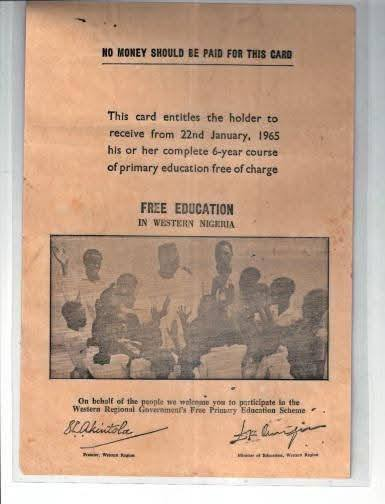
When his bitter rival, Chief Samuel Akintola’s government reissued the Free Education card in 1965 and ensured students could complete primary school without tuition fees, it was an acknowledgment of the scheme’s enduring value and popular support.
Primary Reference: The Development of Free Primary Education Scheme in Western Nigeria, 1952-1966, An Analysis by S. Ademola Ajayi