Bilibili, the Chinese version of YouTube is going global, and Nigeria’s content creators should be paying attention.
By 2022, skit-making had become the third-largest entertainment industry in the country, with a valuation north of ₦50 billion. And the vast majority of Nigerians polled now see comedy content as a legitimate career path rather than a hobby.
But that ecosystem that gave rise to people like Mark Angel, Broda Shaggin, Peller and many others, is now running into a wall. Data costs across major Nigerian telecom providers have jumped by over 65% in a short span, and creators are already feeling it. If the audience is rationing bandwidth, the platforms fighting for that bandwidth matter more than ever. Which is why it’s worth paying attention to a company most Nigerian creators have never seriously considered: Bilibili.
Who is Bilibili?
Calling Bilibili “China’s YouTube” as many people do, is the easy shorthand, and it isn’t wrong, exactly. It’s very much like YouTube but with an important catch.
Bilibili is a publicly traded video platform on both Nasdaq and the Hong Kong exchange, with 376 million monthly active users on its domestic app. It is built around long-form video and a recommendation engine, very much like YouTube.
Nevertheless, calling it ‘China’s YouTube’ undersells what makes it distinct. Bilibili’s signature feature is danmu, or “bullet chat,” or comments that scroll directly across the video in sync with the timestamp. This feature makes watching a clip a shared, real-time experience layered with the audience’s running commentary. It’s a format born out of anime and gaming fandoms, and it has produced a fan culture intense enough that Bilibili’s annual convention drew a reported 400,000 attendees in Shanghai this year.
That’s the platform now making a real push outside China.
Bilibili’s Global Push
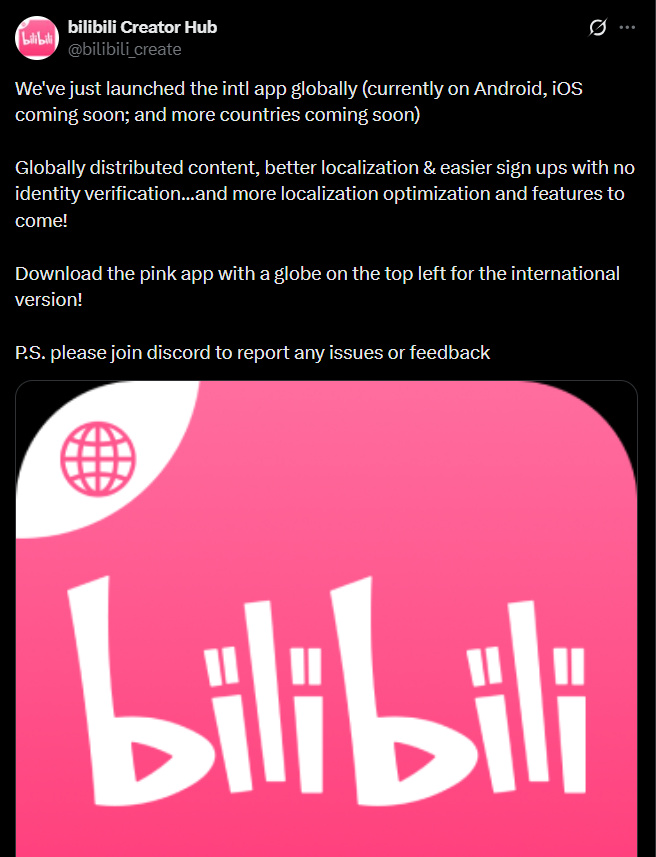
Bilibili’s international app wasn’t new per se. It’s existed on the Play Store for years. It’s been run out of Singapore. But it was a shell of the real product. Outside Southeast Asia, non-Chinese users got voice chat and text posts only. They didn’t get video and no catalogue. Also, signing up required a passport or government ID, which killed casual adoption before it started.
This month that changed as was first reported by Semafor. The ID requirement is gone. Now, anyone can now sign up with an email or phone number. Full video content, including user-generated content and the anime library, is now available globally rather than being geo-fenced. The Chinese and international content libraries are now shared rather than siloed. AI-powered translation has been added.
And, notably, Bilibili is opening a creator marketplace and hiring community managers in Los Angeles, London, São Paulo, Mexico City, Istanbul, and Tokyo. Clearly, the company is trying to seed local creator communities rather than just dump a Chinese app into new app stores. An English-language version of the main website is also reportedly coming, though the company’s own pitch materials describe it as still a work in progress.
At this moment, however, the relaunch is currently available only on Android. iOS availability is listed as “coming soon,” so anyone advising creators to jump on this should note that half the phone market isn’t there yet.
Why this Should Appeal to Nigerian Creators
Nigeria’s creator economy is monetization-hungry and platform-agnostic almost out of necessity. Skit-makers already stack revenue across YouTube ad share, TikTok’s per-view payouts, Instagram brand deals, and direct sponsorships. The reason is because no single platform pays enough on its own, especially when African audiences are monetized at a lower rate than US or European viewers.
That’s actually the more interesting hook here: one industry insider has pointed out that YouTube’s appeal for Nigerian creators has always been partly about access to international audiences where ad rates are simply higher. Bilibili is explicitly courting the same thing: a leaked creator pitch deck describes its target audience as young, affluent, and well-educated, and pitches a marketplace connecting international creators with brand sponsorships.
For a Nigerian skit-maker or commentary creator who is already treating platforms as parallel revenue streams rather than a single home, an early, low-competition platform actively recruiting non-Chinese creators is at minimum worth testing. Especially when the downside of posting a few cross-cut clips is close to zero.
There’s also a content-format angle. Nigerian skit comedy is fast, reaction-driven, and community-commented. Instagram and TikTok comment sections already function as a kind of running audience chorus. Danmu formalizes that instinct into the platform itself. A comedy clip with bullet chat overlaying jokes in real time is arguably a more natural fit for skit culture than YouTube’s static comment thread underneath the video.
The Caveat
None of this comes without the obvious asterisk: Chinese platforms entering Western-adjacent markets have a track record, and it’s mixed. TikTok spent years fighting data-security and moderation battles in the US that nearly got it banned outright. Temu disrupted e-commerce pricing almost overnight and then ran into its own scrutiny over labour practices and product safety.
Bilibili is heading into the same conversation before it’s even fully launched. Sharing content between its Chinese and international platforms while building AI moderation systems out of Singapore raises exactly the kind of censorship and data questions that dogged TikTok. The company hasn’t publicly addressed how it’ll handle content that’s legal in Lagos but not in Beijing, or vice versa.
To be clear, that’s a fair question rather than an established problem. Bilibili hasn’t been accused of specific data violations yet. And there’s been no regulatory action against it, unlike TikTok’s history in the US. It’s also worth remembering that Bilibili didn’t respond to press inquiries about its expansion. This isn’t reassuring, but it isn’t evidence of wrongdoing either.
So, Is It Worth it or Not?
The honest answer is that it’s too early to tell, and that’s fine. But it’s exactly the moment early movers benefit most from showing up. The creator marketplace isn’t live yet. The English website isn’t live yet. iOS isn’t live yet. What is live is a platform with hundreds of millions of existing users, a genuinely different engagement format, an explicit pitch to international creators, and almost no Nigerian presence yet to compete with.
For creators already treating every platform as one more revenue line in a diversified portfolio, that’s less a reason to wait and more a reason to be one of the first accounts there when the audience eventually follow.