
So, you’ve got the idea, you’ve got the hustle, and now you’re ready to make it official. Registering your business with the Corporate Affairs Commission (CAC) is the first formal step to legitimising what you’re building.
According to the CAC:
Registering your business with the CAC gives you full legal recognition under Nigerian law. It enables you to open corporate bank accounts, sign official contracts, and access government or financial services. It also builds public trust by making your business verifiable to partners, clients, and investors, while ensuring ongoing compliance and long-term legitimacy.
The good news is, you no longer need to pay an agent or visit a government office to get it done. The portal is designed for ease of use and self-service.
The entire process is online, and it’s getting faster. CAC has overhauled its registration portal with an AI-powered system designed to simplify the process and accelerate approvals. In fact, as of April 2026, name reservation and business name registration now attract a small AI service charge. ₦200 for name reservation and ₦500 for business name registration. The CAC now processes up to 10,000 applications daily, so the system is well-tested.
The portal is smarter, faster, and more self-sufficient than it used to be. That said, like any large government system, it can occasionally experience hiccups. So if something doesn’t go through the first time, try again during off-peak hours or reach out to CAC support.
Here’s how to navigate it yourself.
Step One: Choose Your Business Structure
Before you touch the portal, you need to decide what kind of business entity you’re registering. There are two common options for most entrepreneurs:
Business Name: This is the go-to for sole proprietors, freelancers, and small partnerships. It’s simpler, cheaper, and quicker to process. Most people reading this guide will start here.
Private Limited Liability Company (Ltd): This is for larger operations with multiple owners or shareholders. It offers legal protection for personal assets but comes with more paperwork, more requirements, and higher fees.
If you’re just starting out, a Business Name is the practical and economical choice. You may not need to go further than this. You can always return to upgrade later.
Step Two: Gather Your Documents
Don’t start filling forms online without having everything ready. Incomplete submissions are one of the most common causes of rejection and delays.
For a Business Name registration, you’ll need:
- A valid means of ID: National Identification Number (NIN), driver’s licence, international passport, or voter’s card
- A recent, clear passport photograph, digitally scanned.
- A scanned signature
- Your business address. A residential address, that is, your home is acceptable.
- Your phone number and email address
- Two to three proposed business names, listed in order of preference
For a Private Limited Company, you’ll additionally need:
- Details of all directors and shareholders (at least one director is required)
- Memorandum and Articles of Association (MEMART). The CAC portal can generate this for you
- Share capital details
- Identification documents for every director and shareholder
Keep your NIN especially handy. The new portal enables applicants to complete company registration using only the NIN of a director or proprietor, with real-time verification. All your scanned documents should be clear and saved in JPG or PDF format as required.
Step Three: Register on the Portal
Head to https://icrp.cac.gov.ng/. This is CAC’s official integrated Company Registration Portal (iCRP). You can also find it through the main site at https://www.cac.gov.ng/.
If you don’t have an account, click Sign Up and register using your email, phone number, or NIN. Verify your account, and you’re in. The whole signup takes under a minute.
Step Four: Reserve Your Business Name
Once logged in, go to Name Reservation or New Application from your dashboard. Enter your two or three proposed names and the system will check availability in real time. The platform offers instant approvals for available names and intelligently suggests alternatives when your preferred options are taken. So even if your first choice is gone, you won’t be left stuck.
If your name is available and approved, you’ll receive an Availability Code (AV Code). This code is what you’ll use to proceed to full registration, so keep it safe. Name reservations are typically valid for 60–90 days.
Step Five: Complete the Registration Form
Back on your dashboard, navigate to Registration > Register New Business. Enter your AV Code, then fill in the relevant pre-registration form. For a Business Name, this is the CAC-BN1 form. You’ll provide:
- Business name, address, nature of business, and commencement date
- Personal details of the proprietor or directors
- Uploaded documents (passport photo, ID, signature). Be sure to do so in the format specified on the portal)
At this step, you should take your time. Errors in spelling or personal details are a common cause of rejections.
Step Six: Pay and Submit
Before submitting, preview the entire application carefully. Once you’re satisfied, proceed to payment via the integrated gateway. You can pay by card or bank transfer.
Approximate fees to expect (though always confirm current figures on the portal, as these are subject to change):
- Business Name: Around ₦10,000–₦12,000 in total, including the name reservation fee and AI service charge
- Private Limited Company: From ₦50,000 and above, depending on share capital
Save your payment receipt, then submit. CAC will review your application, and you can track its status directly from your dashboard.
Step Seven: Download Your Certificate
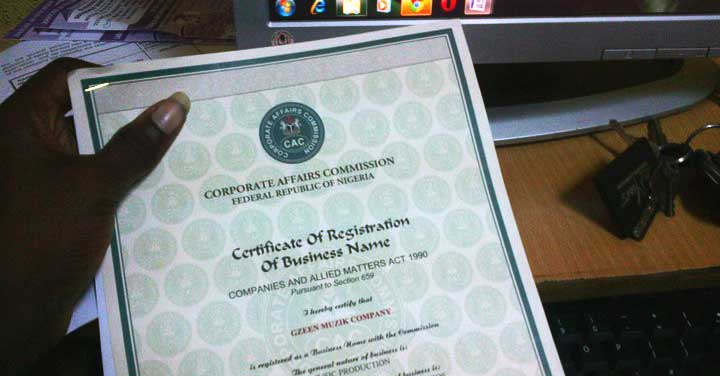
Once approved, your Certificate of Registration will be available to download from the portal. Business names receive a BN Number; companies receive an RC Number. Upon successful NIN verification, a certificate can be generated and sent to your email within 30 minutes. This can occasionally vary depending on system load.
Print the certificate and store it safely. It’s the foundation document for everything else you’ll do as a registered business.
Registration is just the beginning. A few important things to do after you have your certificate:
- Get your Tax Identification Number (TIN) via the FIRS portal. This is increasingly linked automatically at registration
- Open a corporate bank account. Most banks will ask for your CAC certificate
- File annual returns. Companies are required to do this every year. Failing to do so attracts fines and can lead to deregistration
- Register for sector-specific permits if your business requires them (professional bodies, state licences, etc.)