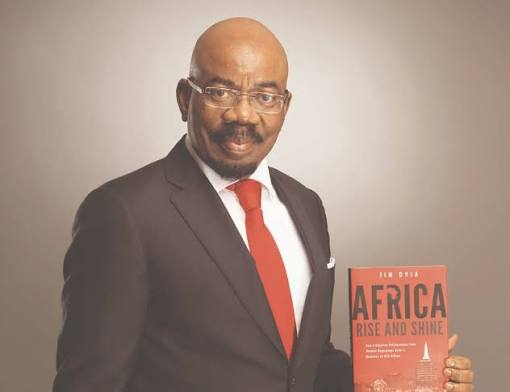
We read Jim Ovia’s Africa Rise and Shine. Here is a distillation of the ten of the most powerful lessons we learnt from the book.
The Seminal Moment
The book opens with a moment in June 2013, with the arrival of a copy of Forbes Africa with Ovia’s day’s mail. On the cover is Ovia himself in a dark suit, sapphire-blue tie and one hand extended as if in greeting. The headline reads: “Why $825 Million Means Nothing to Me.” Below it: “Jim Ovia: The Godfather of Banking.”
For Ovia, it was a moment of disbelief. Here was a boy from Agbor, a small town in Delta State, staring at his own face on a magazine that had to be reprinted four times because it sold out across the continent. “For anyone who has sought to make a mark in the business world,” he writes, “a Forbes Africa cover is a seminal moment—tangible proof that you have done something not just remarkable, but rare—and for me with my humble upbringing, something quite unexpected.”
That a boy from humble beginnings would go on to build a $16 billion institution, is the heart of this book. This is not a memoir, and Ovia is quick to say so. “Certainly, the idea of publishing a memoir or autobiography held no appeal for me,” he writes. “I prefer a book that is less memoir, and more business-focused—a book that describes my business transactions and high-powered deals and details my experience as an entrepreneur.” That is exactly what Africa Rise and Shine delivers: a series of business decisions, negotiations, infrastructure bets, and leadership principles, each grounded in a specific moment.
Gaps Are Entry Points
The most important mental shift in the entire book comes early, and it is worth quoting at length because it is the thesis on which everything else rests:
“Africa’s challenges may appear daunting to most, but to those with the right entrepreneurial vision, challenges always provide opportunities. Poor infrastructure? The entrepreneur sees that as a chance to leverage structural improvements as a core component of a burgeoning brand identity. Inadequate supply of electricity? The entrepreneur identifies such a deficiency as a blank slate on which a new electricity supply can be built.”
This is not motivational fluff as the man who wrote the words drew them from his own life. When he started Zenith Bank in 1990, Nigeria’s banking sector was a graveyard of failed institutions. Infrastructure was decaying. The economy was unstable. Foreign investment was scarce. Most people looked at that environment and saw reasons not to build. Ovia looked at it and saw a blank slate.
The book opens with a striking historical contrast: in May 2000, The Economist ran a cover story calling Africa “The Hopeless Continent.” Over a decade later, the same magazine reversed itself with “Africa Rising,” illustrated by a child flying an Africa-shaped kite painted in rainbow colors. Ovia’s point is not that the pessimists were wrong about the challenges. It is that the pessimists misread what challenges are for. He writes:
“For anyone who has the intuitive entrepreneurial capacity to envision obstacles as entry points to brand building, and the vision to translate ‘not yet’ into ‘finally now,’ the climate in Africa can provide a richly fertile bed in which to seed new business.”
This is the first and most important lesson: the gap is the business. The unreliable power grid is why generators, solar installations, and backup systems are viable businesses. The broken logistics chains are why delivery startups can scale. The trust deficit in financial services is why a bank that invests in reliability and transparency can win. Ovia did not build Zenith Bank despite Nigeria’s problems. He built it because he understood that solving those problems, reliably, at scale, with a brand people could trust, was the business.
Lesson 1: Your Gut Is Data, Learn to Read It
Ovia devotes an entire chapter to “Basic Instinct: Going with the Gut,” and it is one of the most refreshingly honest treatments of intuition in business literature. He does not dress it up as mysticism. He treats it as pattern recognition, that is, the accumulated wisdom of experience, compressed into a feeling.
The story of Zenith Bank’s founding is the clearest example. Ovia had worked in banking for years. He had watched institutions rise and fall. He had seen what worked and what did not. When the opportunity came to apply for a banking license, he did not commission a 200-page feasibility study. He moved. “I had a vision,” he writes, “and I acted on it.” The license application process was not a matter of waiting for perfect conditions. It was a matter of seizing a window.
But the gut is not enough on its own. Ovia pairs instinct with something he calls “unwavering ethical stance.” In the book’s foreword material, David Applefield of the Financial Times captures this well: Ovia’s model is “believing in yourself, aiming for excellence, building a team, and listening to your gut—all with an unwavering ethical stance.” The gut tells you when to move. The ethics tell you how to move. Without the latter, the former is just recklessness.
Our instincts are not irrational. They are the sum of everything we have observed, often below the level of conscious thought. But they must be disciplined by a clear ethical framework. Ovia’s gut told him to start a bank. His ethics told him to build one that people could trust with their money. That combination is what made Zenith last.
Lesson 2: Negotiation Is About Trust, Not Just Tactics
In the chapter “The Power of Negotiation: Instinct and Trust” Ovia does not offer the standard win-at-all-costs playbook. Instead, he argues that the best deals are the ones where both sides walk away feeling they have been treated fairly, because those are the deals that lead to repeat business, referrals, and long-term partnerships.
The Prudential Zenith Life Insurance partnership is his case study. Matt Lilley, CEO of Prudential Africa, writes in the book’s praise pages: “Having personally negotiated with Jim Ovia to create the landmark Prudential Zenith Life Insurance partnership, I have seen his artistry at deal making firsthand. Jim’s ability to step back and take a long-term perspective has been a key factor in his business success.” Lilley adds, with disarming honesty: “How I wish I had read Africa Rise and Shine prior to sitting down to the negotiation table with him!”
The “artistry” Lilley refers to is not about squeezing the last naira out of a deal. It is about understanding what the other side actually needs, and structuring a deal that delivers it. Ovia’s approach is patient. He takes the long view. He builds trust before he builds terms. In a Nigerian context where business relationships are often transactional and trust is scarce, this is a radical approachm and a competitive advantage.
Lesson 3: Branding Is Not Cosmetic — It Is Strategic
Ovia devotes an entire chapter to “Logo and Branding,” which might seem like an odd priority for a banker. But for Ovia, the Zenith brand was never an afterthought. It was a core strategic asset.
Think about the context. In 1990s Nigeria, banks were not trusted. Many had collapsed. Others were seen as vehicles for their owners’ personal enrichment. Customers had no reason to believe that a new bank would be any different. Ovia understood that the brand from the logo, the colors, the physical presence and the consistency of experience, was how he would communicate trust before a single transaction took place.
The Zenith brand was built to signal stability, professionalism, and modernity. The name itself, Zenith, the highest point, was aspirational. The visual identity was clean and confident. The branches were designed to feel solid and welcoming. Every touchpoint was an argument: you can trust us with your money.
This was not vanity. It was strategy. “Poor infrastructure?” Ovia writes. “The entrepreneur sees that as a chance to leverage structural improvements as a core component of a burgeoning brand identity.” The brand was the structural improvement. It was the promise that Zenith would be different, and the discipline to keep that promise, transaction after transaction.
Lesson 4: Technology Is Not Optional — It Is the Great Leapfrog
Two of the most important chapters in the book are “Building the Information Superhighway” and “Don’t Agonize, Digitize!” Ovia was early to understand that Africa’s lack of legacy infrastructure was not necessarily a disadvantage but an opportunity to leapfrog.
While Western banks were burdened with decades of legacy systems, Zenith could build modern, digital-first infrastructure from scratch. Ovia invested heavily in technology when many Nigerian banks saw IT as a cost center. He built the information superhighway before it was fashionable. He digitized processes when competitors were still drowning in paper.
The results were transformative. Zenith Bank became known for reliability and speed; it became reputed as the bank that worked when others didn’t. In a country where “network down” was a daily refrain, Zenith’s investment in uptime was a competitive moat. Customers noticed. They stayed. They told others.
Ovia’s chapter on BYOI (Build Your Own Infrastructure) extends this principle beyond technology. He argues that in Africa, you cannot wait for the government or the utility companies or the telecoms to solve your problems. You must build what you need. Zenith built its own power systems, its own security, its own logistics. This was expensive, but it was also liberating. It meant the bank could operate on its own terms, not at the mercy of external failures.
Lesson 5: Grow Aggressively, But Grow Deliberately
Ovia’s chapter “Growing Zenith Aggressively” is a masterclass in scaling discipline. He was not content with a single branch or a niche customer base. He wanted Zenith to be a national institution, then an international one. But he did not grow recklessly.
The book describes a methodical expansion: opening branches in strategic locations, hiring and training staff rigorously, building systems that could handle increased volume, and, crucially, maintaining the quality of service that had built the brand in the first place. Growth was aggressive, but it was not chaotic. It was planned, sequenced, and resourced.
The Initial Public Offering (IPO) was a key milestone. Taking Zenith public did more than raise capital for the bank. It forced the bank to adopt the governance standards of a public company; it opened the door to international investors. And most importantly, it signaled that Zenith was playing in the big leagues.
The London Stock Exchange listing was the culmination of this trajectory. Aliko Dangote, in the book’s praise pages, notes that Ovia’s “principles of doing business can be applied globally as demonstrated by Zenith Bank’s London Stock Exchange listing.” That listing was not an accident. It was the result of years of deliberate, disciplined growth.
The lesson here is that growth is not just about adding more. It is about adding better. Every new branch, every new product, every new market must be resourced and ready. Aggressive growth without discipline is how banks fail. Ovia grew aggressively with discipline, and that is why Zenith survived when others didn’t.
Lesson 6: Owner-President Management (OPM) — Skin in the Game
One of Ovia’s most distinctive ideas is what he calls “Owner-President Management” (OPM). The concept is simple: the people running the business should have significant personal wealth tied to its success. They should think like owners, not hired hands.
Ovia lived this principle. He was not a detached CEO collecting a salary. His fortune was tied to Zenith’s performance. He felt every loss personally. He celebrated every win as his own. This alignment of incentives drove a level of commitment and attention to detail that is hard to replicate in a purely professional management structure.
But OPM is not just about the top person. Ovia extended the principle throughout the organization. Staff were given ownership stakes, performance bonuses tied to the bank’s profitability, and a genuine sense that they were building something together. The legendary Zenith Bank CEO Awards were part of this culture. Recognition, reward, and ownership created a workforce that was not just employed but invested.
Lesson 7: Philanthropy Is Not Charity — It Is Strategy
The Jim Ovia Foundation and the chapter on philanthropy are often treated as a footnote in business books. But for Ovia, philanthropy is integral to the business model, not an add-on.
His giving is focused on education, entrepreneurship, and health, three areas he believes are most critical to Africa’s development. James Hope College, which he founded, is a flagship example. It is not a charity school in the traditional sense. It is a center of excellence, designed to produce the kind of graduates who can compete globally. The school’s motto (Excellence and Empowerment) reflects Ovia’s belief that education is the most powerful lever for change.
The Private-Sector Health Alliance is another example. Ovia understands that a healthy workforce is a productive workforce. Investing in health infrastructure is not just altruism. It is building the conditions for business to thrive.
Lesson 8: The Big Bet — Visafone and the Mobile Revolution
Perhaps the most audacious decision in the book is Ovia’s founding of Visafone, a mobile telephone company. This was a completely different industry from banking. It required different expertise, different infrastructure, different regulatory relationships. But Ovia saw an opportunity: Nigeria’s telecoms market was underserved, and mobile phones were about to transform the continent.
The Visafone story is a case study in boldness. Ovia did not dip a toe in. He committed. He built infrastructure, acquired spectrum, hired talent, and launched a brand. And when the time came, he sold it to MTN, in a deal that validated the bet. The chapter “How and Why MTN Bought Visafone” is a fascinating look at how a well-built business, even in a challenging market, can become an attractive acquisition target.
Lesson 9: Crisis Is a Test of Character — and Systems
The chapter on the Nigerian banking crisis is essential reading for anyone who wants to understand how institutions survive when the environment turns hostile. Ovia does not dwell on the drama. He focuses on the systems: liquidity management, risk controls, governance, and the discipline to say no to bad loans.
Zenith Bank not only survived the crisis. It emerged stronger. This was not luck. It was the result of years of building systems that could withstand shocks. Ovia’s insistence on ethical lending, transparent governance, and conservative risk management — the “unwavering ethical stance” — paid off precisely when it mattered most.
Lesson 10: Work/Family Ethic — The Whole Life
The chapter “Work/Family Ethic of an Entrepreneur” is one of the most personal in the book. Ovia does not present himself as a workaholic who sacrificed everything for the bank. He presents himself as someone who understood that family is the foundation on which professional success is built.
His dedication at the front of the book is telling: “I would like to dedicate this book to my family, particularly my wife and children, who are a continual source of inspiration to me.” This is not boilerplate. Throughout the book, Ovia returns to the theme of balance. An entrepreneur who is depleted, disconnected, and unhappy is not going to build a great institution. The whole person builds the whole business.
The Civic Dimension
In two chapters (Civic Towers and Networking, Networking, Networking) Ovia argues that business does not exist in a vacuum. Civic Towers, a real estate development, was not just a property investment. It was a statement about what Lagos could be: a modern, world-class city with infrastructure to match its ambition.
And networking? Ovia is unapologetic about its importance. He built relationships across sectors, across generations, across continents. The Harvard Lecture, the Global Summits, the Central Bank Governor nomination were honours as well as nodes in a network that Ovia cultivated deliberately over decades. He understood that in Nigeria, as elsewhere, opportunity flows through relationships.
“If I Can Do It, You Can, Too”
The most important sentence in Africa Rise and Shine appears on page 14, in the prologue:
“It has been my wish for a long time that the young people of my home country of Nigeria—and throughout Africa—take advantage of the tremendous opportunities Africa has to offer. The path to success is accessible to every young African person, regardless of background, family income, or education. This has been said many times, but I repeat it sincerely now—if I can do it, you can, too.”
This line is the reason the book exists. Ovia did not write Africa Rise and Shine to burnish his legacy. He wrote it because he believes, genuinely, that the principles that built Zenith Bank can be learned and applied by anyone with the discipline and the vision to try.
The book’s twelve rules for building profitable businesses are not secret formulas. They are disciplined habits: listen to your gut, build trust, invest in branding, embrace technology, grow deliberately, align incentives, give back, take bold bets, manage risk, balance work and family, build your network, and never stop learning. None of these are revolutionary. What makes them powerful is that Ovia actually did them, in one of the most difficult business environments in the world, and built a $16 billion institution as a result.
This review is part of the SimplVest “What We’re Reading” series, exploring books that offer practical wisdom for Nigerian entrepreneurs and investors. Jim Ovia’s Africa Rise and Shine is published by ForbesBooks and is available at major book retailers.