Nigeria’s rubber industry was once a pillar of the nation’s agricultural exports. It is now teetering on the brink of collapse. This article examines why Nigeria’s rubber industry collapsed, the lingering potential for revival and actionable solutions to prevent its total demise.
By Joshua I. Mokwuah | August 14, 2026
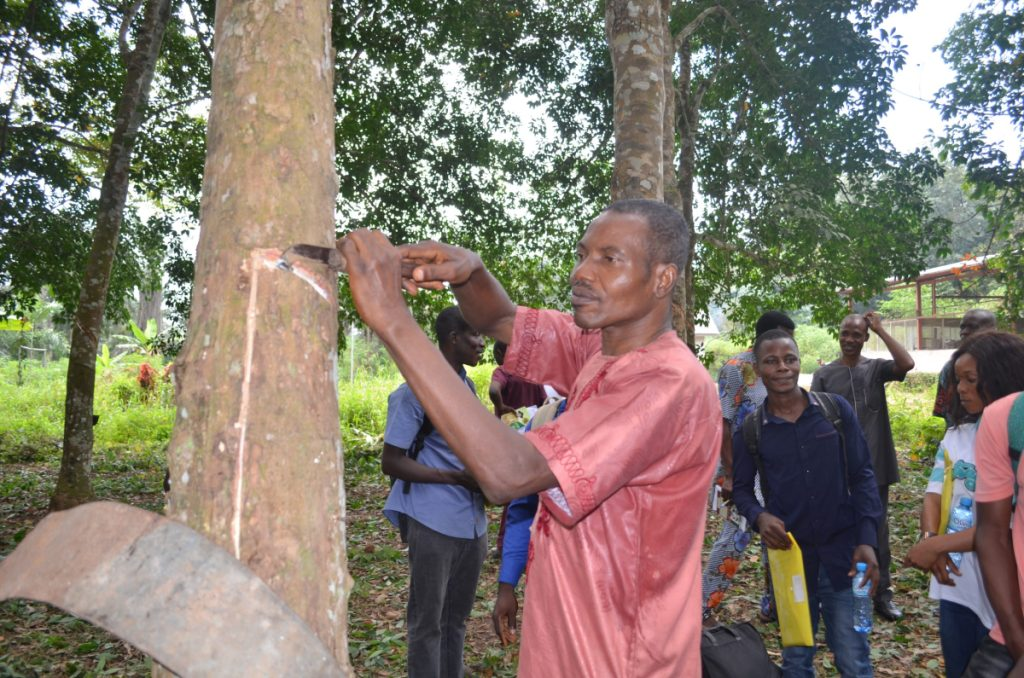
The Boom
In the 1960s, Nigeria was a leading global producer of rubber and commanded respect in international markets whilst serving as a crucial foreign exchange earner. The industry thrived with well-managed plantations, robust processing facilities and strong government support through the Commodity Marketing Boards (CMBs), which provided price stability and farmer protection. But the SAP program of the late 1980s saw the scraping of the CMBs, which in an ironic twist, helped the industry but only briefly.
By 2023, the country was spending over N1.3 trillion annually on rubber imports. This represents a shocking 106% increase from 2013. Meanwhile, local production stagnates at a meagre 149,000 metric tons, with aging plantations, low yields and a lack of investment crippling the sector.
The consequences of this decline are dire. Thousands of smallholder farmers, who once relied on rubber for their livelihoods, have abandoned their plantations. Major producers like Okomu Oil have exited rubber farming due to extortion and insecurity, further shrinking domestic output and leaving Nigeria increasingly dependent on costly imports. The Managing Director of Okomu Oil Palm Plc, Graham Hefer said that the company’s exit of the rubber business in 2023 was mostly due to insecurity and attacks on the company’s facilities.
Yet, rubber remains a strategic crop that is essential for tires, medical supplies and industrial products, meaning Nigeria’s reliance on imports weakens its economy and exposes it to global supply shocks. And despite recent challenges, there are signs of renewed interest. Nigeria’s natural rubber market, valued at $85 million in 2024, shows potential for growth with proper intervention. The sector’s resilience is evidenced by production levels maintaining around 149,000 metric tons despite significant challenges.
Nigeria’s Diminishing Global Position
Africa’s contribution to the production and consumption of natural rubber is still not significant as the continent only accounts for 10% of world supplies, with Nigeria’s share continuing to shrink. In West Africa’s total natural rubber production of about 1.1 million tonnes, Nigeria contributes only 4.6%, while Côte d’Ivoire dominates with 82.4%, Liberia holds 9.1%, and Cameroon accounts for 3.9%.
Meanwhile, Côte d’Ivoire is set to become the world’s third-largest natural rubber producer by volume, with exports projected to reach $936 million by 2026. This stark contrast highlights Nigeria’s failure to capitalize on the multi-billion-dollar opportunity in the global rubber market, estimated at $49 billion and projected to reach $64 billion by 2028.
Reasons for The Decline of Nigeria’s Rubber Industry
1. The Oil Boom and the Abandonment of Agriculture
The discovery of crude oil in the late 1950s marked the beginning of rubber’s decline. It also spelt the end for commodities that dominated Nigeria’s export economy including groundnuts, cocoa, palm oil and cotton. As petroleum revenues surged, successive governments shifted focus away from agriculture, leaving rubber plantations to wither. According to the National Rubber Association of Nigeria (NRAN), rubber was once Nigeria’s fourth-largest foreign exchange earner, but today, it contributes a paltry 0.15% to exports.
2. Aging Plantations and Low Productivity
A critical issue plaguing Nigeria’s rubber sector is the prevalence of old, low-yielding trees. Most plantations were established over 30 years ago and have long passed their peak latex-producing years 2. Unlike Malaysia and Indonesia, which adopted high-yielding clones, Nigeria still relies on outdated varieties, producing less than half the global average yield per hectare.
Dr. Timothy Esekhade of the Rubber Research Institute of Nigeria (RRIN) warns that without massive replanting efforts, Nigeria’s rubber output will continue to dwindle. However, rubber trees take 6-7 years to mature, meaning any revival strategy must begin immediately to see results in the next decade.
In 2023, Dr. Lelia Nkechinyere Dongo, executive director of RRIN, speaking to Business Day emphasized the sector’s potential: “There is virtually no sector of life that has no need for it.” She revealed that it has 50 products in over 400,000 applications. She stressed that policymakers should focus on rubber’s vast benefits rather than being deterred by the long gestation period.
3. Collapse of Processing and Industrial Demand
The exit of multinational tire manufacturers Michelin and Dunlop in the 2007 and 2008 respectively, with Dunlop exiting after recording a net loss of £10.88 million for the fiscal year, was the decisive deathblow to Nigeria’s rubber value chain. These companies, who controlled up to 75% of Nigeria’s tyre market, not only provided a steady market for latex but also drove local processing and industrial demand.
Today, less than 2% of Nigeria’s rubber is processed domestically, with most exported raw to Europe and Asia. The reported reason was the lack of cheap electricity, which is beyond plausible, since affordable electricity is the backbone of manufacturing across the world.
Another reason for the reduction of import tariffs on tyres from 10% to 40% in 2006 by the administration of President Olusegun Obasanjo. This significantly affected local manufacturers of the product and led to the explosion of the lower-quality Tokunbo tyre market with their market share reaching up to 90%. Clearly, without a strong industrial base, Nigeria misses out on higher-value rubber products, such as tires, footwear and medical supplies which could generate billions in revenue and jobs.
4. Land Tenure and Insecurity
Land acquisition remains a major hurdle for rubber expansion. The communal land tenure system makes it difficult for investors to secure large tracts for plantations, while insecurity in the Niger Delta, where most rubber is grown, deters commercial farming.
The management of Okomu Oil Palm Plc had repeatedly raised concerns that its multi-billion-naira investment in Edo State is at risk due to repeated militant disruptions and attacks on its personnel. This insecurity has become so severe that it forced one of Nigeria’s largest agricultural companies to abandon rubber production entirely.
How Nigeria Can Save Its Rubber Industry
Despite these challenges, Nigeria’s rubber sector is not beyond saving. With the right policies, investments, and modernization strategies, the country could reclaim its place as a major producer. Below are key solutions:
1. Massive Replanting and High-Yield Clones
The first step toward recovery involves replacing aging trees with high-yielding varieties. Malaysia’s success was built on tenera hybrids, which produce 3-4 times more latex than Nigeria’s traditional trees. The Rubber Research Institute of Nigeria has developed improved clones (NIG800/NIG900 series), but adoption remains low due to high seedling costs and inadequate farmer support.
Igbinosun Idowu, national president of NARPPMAN, emphasized the urgency: “Most plantations, particularly smallholdings, were established more than 30 years ago and have passed their economic thresholds. Re-planting some of these farms has been difficult because of poor management and funding.” The solution requires government intervention through subsidized seedlings and fertilizers, partnering with institutions like the Central Bank of Nigeria to provide low-interest loans for replanting programs.
2. Rubber Agroforestry
One innovative solution gaining traction is rubber agroforestry, where rubber is intercropped with food crops like cassava, plantains, and yams. This approach, piloted by the World Agroforestry Centre (ICRAF), allows farmers to earn income during the 6-7-year wait before rubber trees mature.
In Delta State, farmers like Ben Egbune have successfully adopted this model, using 15 workers per hectare and selling rubber seedlings for additional income. Scaling this system nationwide could revive rural economies while boosting rubber output, addressing both food security and rubber production simultaneously.
3. Reviving Local Processing and Industrial Demand
To reduce reliance on raw exports, Nigeria must rebuild its rubber-processing capacity. The French Development Agency has pledged $100 million for rubber outgrower schemes in the Niger Delta, providing a foundation for industrial revival.
Dr. Dongo advocated for local processing development: “Nigeria should tap into the endless benefits from rubber. Policy members should focus attention on rubber as well as do other countries who are reaping from rubber.” The government should incentivize tire manufacturers to return through tax breaks or public-private partnerships, while promoting local production of medical gloves, shoe soles, and automotive parts.
4. Policy Reforms and Security Measures
NARPPMAN has ambitious plans for sector revival. Peter Igbinosun, the association’s president, revealed plans for massive rubber cultivation aimed at creating 640,000 direct jobs, with an additional 160,000 people employed as service providers. The association plans to establish 160,000 hectares of rubber plantations across 24 states over the next decade.
Currently, Nigeria has approximately 200,000 hectares of rubber plantations managed by smallholders and industrial operations. Igbinosun emphasized that “the rubber industry alone could provide over 800,000 employment, making it a goldmine.”
5. Policy Reforms and Security Enhancement
Comprehensive policy reforms are essential for sector revival:
- Land Reforms: Simplify land leasing procedures for agricultural use to attract corporate investors
- Security Enhancement: Implement robust security measures to crack down on extortion and vandalism in rubber-growing regions
- Export Incentives: The Nigerian Export Promotion Council should prioritize rubber in its $10 billion non-oil export target
- Financial Support: Enhanced funding through development finance institutions and commercial banks
6. International Collaboration and Sustainability
With the Global Platform for Sustainable Natural Rubber (GPSNR) pushing for eco-friendly production, Nigeria could access premium markets by adopting sustainable tapping practices and zero-deforestation policies. This approach would align with international environmental standards while commanding higher prices for Nigerian rubber.
The involvement of international organizations like the International Rubber Study Group (IRSG) and the Common Fund for Commodities provides opportunities for technical assistance and funding support.
Nigeria’s Rubber Crossroads
Nigeria’s rubber industry stands at a critical crossroads. The convergence of aging plantations, security challenges, inadequate processing capacity, and policy neglect has created a perfect storm threatening the sector’s existence. Yet, the fundamentals for revival remain intact: suitable climate, available land, existing expertise, and growing global demand.
The contrast with neighbouring countries is instructive. Côte d’Ivoire’s success stems from consistent government support, modern processing facilities, and strategic partnerships with international buyers. Ghana’s recent revival through GIRSAL’s initiatives, which created over 60 permanent jobs and sustained employment for 2,700 workers, demonstrates what’s possible with focused intervention.
These success stories provide blueprints for the potential comeback of Nigeria’s rubber industry. They emphasize the importance of integrated value chain development, from production through processing to marketing. The lessons from Malaysia, Côte d’Ivoire, and recent Ghanaian success prove that rubber can still be a lucrative, job-creating industry. Nigeria’s choice is stark: act decisively now to revive this strategic sector, or watch helplessly as the last rubber tree is cut down, forever closing the door on what was once a source of national pride and economic prosperity.