One of the five pillars of Islam, Zakat connects personal faith with social responsibility. For Nigerian Muslims, understanding how to properly calculate and distribute Zakat has never been more important. This comprehensive guide will walk you through everything you need to know about how and where to pay Zakat in Nigeria.
Understanding Zakat
Zakat, derived from the Arabic word meaning “purification” and “growth,” is an obligatory form of almsgiving that stands alongside prayer (salah), fasting (sawm), pilgrimage (Hajj), and the declaration of faith (shahadah) as one of Islam’s five fundamental pillars. Unlike voluntary charity (Sadaqah), Zakat is mandatory for every sane, adult Muslim who possesses wealth above a certain threshold.
The obligation is straightforward: every eligible Muslim must pay 2.5% of their qualifying wealth annually to support those in need. Besides being a tax or donation, it’s also an act of worship that purifies wealth and redistributes resources within the Muslim community and ensures that prosperity reaches the most vulnerable members of society.
Who Must Pay Zakat?
Before exploring payment methods, it’s crucial to understand eligibility. You are required to pay Zakat if you meet these criteria:
Personal Requirements:
- You are a sane, adult Muslim
- You are debt-free or your assets exceed your immediate debts
- You have possessed wealth above the nisab threshold for one complete lunar (Islamic) year
Nisab Threshold:
The nisab is the minimum amount of wealth that makes Zakat obligatory. It’s calculated based on the value of either gold (87.48 grams) or silver (612.36 grams). As of October 3, 2025, the nisab threshold in Nigeria is approximately ₦15,357,440 according to reports from the National Moonsighting Committee Nigeria. However, some sources cite different figures based on silver values, so it’s advisable to consult with local Islamic authorities for the most current nisab value.
This threshold exists to ensure that only those with surplus wealth beyond their basic needs contribute Zakat as a way of protecting those still building their financial stability.
Regarding when to pay Zakat, it becomes due immediately upon completing one lunar year of possessing wealth above the nisab. Many Muslims choose to pay during Ramadan to maximize blessings, but you can pay whenever your personal Zakat year concludes. Some scholars permit paying in advance, while others recommend paying exactly when due.
Most organizations that accept regular Zakat also facilitate Zakat al-Fitr payments during Ramadan. In addition to annual Zakat (Zakat al-Mal), Muslims must pay Zakat al-Fitr (Fitrana) during Ramadan before Eid prayers. This separate obligation purifies the fast and provides for those in need during Eid celebrations. It is due on every household member regardless of age or wealth, equals the cost of one meal per person and must reach recipients before Eid prayers
How to Calculate Your Zakat
Calculating Zakat involves a systematic assessment of your zakatable assets minus permissible deductions. When in doubt about your calculations or eligibility, you can consult knowledgeable Islamic scholars. Organizations like the Association of Zakat and Waqf Operators in Nigeria (AZAWON) can provide guidance.
However, here’s a general break down:
Zakatable assets include all your cash, that is, money in bank accounts, at home, or owed to you. Your savings, inlcuding your investment accounts, emergency funds, and savings are zakatable. Also zakatable are your gold and Silver, jewellery, coins and bullion, your business assets including, inventory, goods for trade, and business cash; stocks, shares, and other financial instruments as well as your investment properties, excluding your primary residence.
When calculating your net zakatable wealth, you are allowed to deduct debts that must be repaid within the next 12 months. You are also allowed to deduct up to 12 months’ worth of instalments on longer-term debts as well as arrears and overdue payments. However, bills and expenses not yet due cannot be deducted. Also, debt payments not due within the next 12 months, interest payments (as riba is haram) and long-term debts like mortgages and student loans (only deduct amounts currently due or overdue), are not deductible.
The Calculation Formula
Total Zakatable Assets – Deductible Liabilities = Net Zakatable Wealth
If your net zakatable wealth equals or exceeds the nisab threshold, you owe Zakat at 2.5% of that amount.
Example: If your net zakatable wealth is ₦15,000,000:
Zakat Due = ₦15,000,000 × 0.025 = ₦375,000
Use Imaanity’s Digital Zakat Calculator
Imaanity.com has a digital Zakat calculator that covers everything from liquid cash to illiquid assets to help you arrive at your precise obligation without guesswork or omission.
- It is free. To use it, you just need to sign up.
- You can save and track your Zakat calculations
- It allows instant access to your calculation history
- And you get personalized recommendations
Why You Should be More Intentional About Paying Zakat
Recent statements from Islamic leaders highlight a critical issue affecting Zakat in Nigeria. Sheikh Fuad Adeyemi, the National Chief Imam of Al-Habibiyyah Islamic Society, has emphasized that zakat distribution in Nigeria is often ineffective due to improper allocation to beneficiaries. During the 4th National Zakat Day in February 2025, he stressed that “there is no poverty in Islam” and that the real problem lies in Muslims not giving zakat properly as prescribed by Allah.
The imam’s criticism of the practice focuses on a common practice: distributing inadequate amounts that don’t enable recipients to invest and generate wealth. True Zakat distribution should empower recipients to break the cycle of poverty, not merely provide temporary relief. A recipient should not need to repeatedly receive Zakat unless affected by unforeseen circumstances like natural disasters.
In other words, unlike simple handouts, strategic Zakat distribution should provide capital for small business development, skills training and educational scholarships. When recipients receive sufficient amounts to invest in income-generating activities, they transition from Zakat receivers to Zakat payers. For example, Muhammad Lawal Maidoki, Chairman of the Association of Zakat and Waqf Operators in Nigeria (AZAWON), noted that in some areas of Jigawa State and other northern regions, Zakat had to be transferred elsewhere because proper distribution had eliminated local poverty.
This view means that those paying Zakat should choose reputable, well-structured organizations, and those who understand the transformative potential of proper Islamic charity, when paying your Zakat.
Where to Pay Zakat in Nigeria
Traditional Channels
1. Local Mosques
The most accessible option for most Nigerian Muslims remains the local mosque. Friday mosques typically have established Zakat committees that collect and distribute funds within the community. This traditional method offers multiple advantages including direct community impact, the chance of personal connection with recipients and immediate distribution. Regardless, paying Zakat to your local mosque means that you may not get proper documentation.
Also, there are chances that the standards of distribution will not be consistent across all local mosques. When giving through your mosque, speak with the imam or Zakat committee chairperson to understand their distribution methodology and how they select beneficiaries.
2. Islamic Societies and Organizations
Several established Islamic societies across Nigeria accept and distribute Zakat:
Al-Habibiyyah Islamic Society (AIS) Based in Abuja, AIS operates the Al-Habibiyyah Zakat & Endowment Foundation, which hosts annual National Zakat Days with public disbursements. In February 2025, they distributed ₦15 million to 90 beneficiaries in the Paduma community through cash, education scholarships, and empowerment materials.
Muslim Public Affairs Centre (MPAC) Nigeria MPAC Nigeria is Zakat-eligible and accepts Zakat donations for Islamic causes and community services. They emphasize using Zakat funds exclusively for eligible purposes, not administrative expenses like rent or banquets.
Sakinah Medical Outreach This organization accepts Zakat donations specifically for healthcare initiatives and provides medical services to underserved Muslim communities. Their focus on healthcare makes them ideal for those wanting their Zakat to address medical needs.
3. State and Regional Zakat Boards
Some northern Nigerian states have established formal Zakat and Hubusi Boards that collect and distribute Islamic charity. These government-affiliated agencies provide structure and accountability, though experiences vary by state.
Online Payment Options
The digital revolution has made paying Zakat more convenient, transparent, and accessible. Here are platforms where Nigerian Muslims can pay their Zakat online:
1. Imaanity
Inspired by effective altruism, Imaanity is an evidence-based giving platform that is built on the principle that donors deserve to know whether their giving is actually working. Imaanity independently assesses NGO partners on the ground in Nigeria across the categories where need is most acute: poverty relief, healthcare, education, clean water, emergency response, and support for women, children, and families.
Imaanity is one hundred percent Shariah-compliant. Its free digital Zakat calculator covers everything from liquid cash to illiquid assets to help you arrive at your precise obligation without guesswork or omission. They cover operational costs independently. This way, they ensure that 100% of donated funds reach their partner organisations. They provide seamless and convenient payment options. Donors can direct their contributions to specific geographical locations of their choice instead of just dump them into undifferentiated pools. Also, donors can also track the impact of their giving in real time.
2. Islamic Relief Worldwide
They have a comprehensive Zakat calculator, transparent reporting and global reach. Their Zakat targets emergency relief, education, healthcare, and sustainable development. Their payment methods include credit/debit cards and bank transfers. IRW is a well-established international charity with decades of experience, meaning they can be trusted. Their website is islamic-relief.org.
3. Muslim Aid
This organization distinguishes itself through detailed, country-specific programs that allow donors to see how their Zakat impacts particular regions. Their focus areas resonate with pressing needs across the African continent, water projects that provide clean drinking water to communities, orphan support programs that care for vulnerable children, and emergency relief that responds to crises as they emerge. Muslim Aid supports various online payment methods, making the donation process straightforward for Nigerian users regardless of their banking preferences.
4. Zakat Foundation of America
The Zakat Foundation of America brings American organizational standards to international Zakat distribution, including throughout African countries. Their scope extends across more than forty nations globally, allowing Nigerian donors to contribute to a truly international network of assistance. The foundation’s programs include orphan sponsorship that provides ongoing support for vulnerable children, Gaza aid addressing one of the Muslim world’s most pressing humanitarian crises and community empowerment initiatives that help entire neighborhoods lift themselves out of poverty. While not exclusively Nigerian-focused, their international operations ensure your Zakat can support Muslims facing hardship across diverse contexts.
5. LaunchGood
LaunchGood presents an entirely different approach to online Zakat. Rather than functioning as a traditional charity, LaunchGood operates as a crowdfunding platform for Islamic causes which gives donors unprecedented choice in how their Zakat is deployed. You can browse through specific projects, and direct your Zakat exactly where your heart leads you. The platform allows you to track your Zakat contributions annually and edit your calculations as your financial situation changes.
How to Choose an Online Platform
When selecting an online platform for your Zakat, consider these factors:
- Shariah Compliance: Verify that the organization has obtained fatawa (Islamic rulings) from recognized scholars that confirm their Zakat eligibility
- Transparency: Look for detailed financial reports showing how Zakat funds are distributed
- Administrative Costs: Prefer organizations with clear policies on whether Zakat funds cover administrative expenses
- Distribution Areas: Ensure your Zakat reaches the eight categories of recipients specified in the Quran (Surah At-Tawbah, 9:60), including the poor (Al-Fuqara), the needy (Al-Masakin), Zakat administrators, those whose hearts are to be reconciled, those in bondage, those in debt, in the cause of Allah and wayfarers. Some platforms allow you to specify particular regions or causes you intend your Zakat to reach.
- Security: Verify that payment systems are secure and encrypted
- Receipts: Choose platforms that provide documentation for your records
- Reputation: Research the organization’s track record and beneficiary feedback
Imaanity: An Evidence-Based Way to Pay Zakat
The distance between a charity’s stated mission and its actual impact is frequently wider than donors know. An organization can be sincerely motivated, competently managed, and genuinely popular and still fail to produce meaningful change in the metrics that matter. Being diligent about paying your zakat means asking not just how much but to what effect. This has given rise to effective altruism and evidence-based giving.
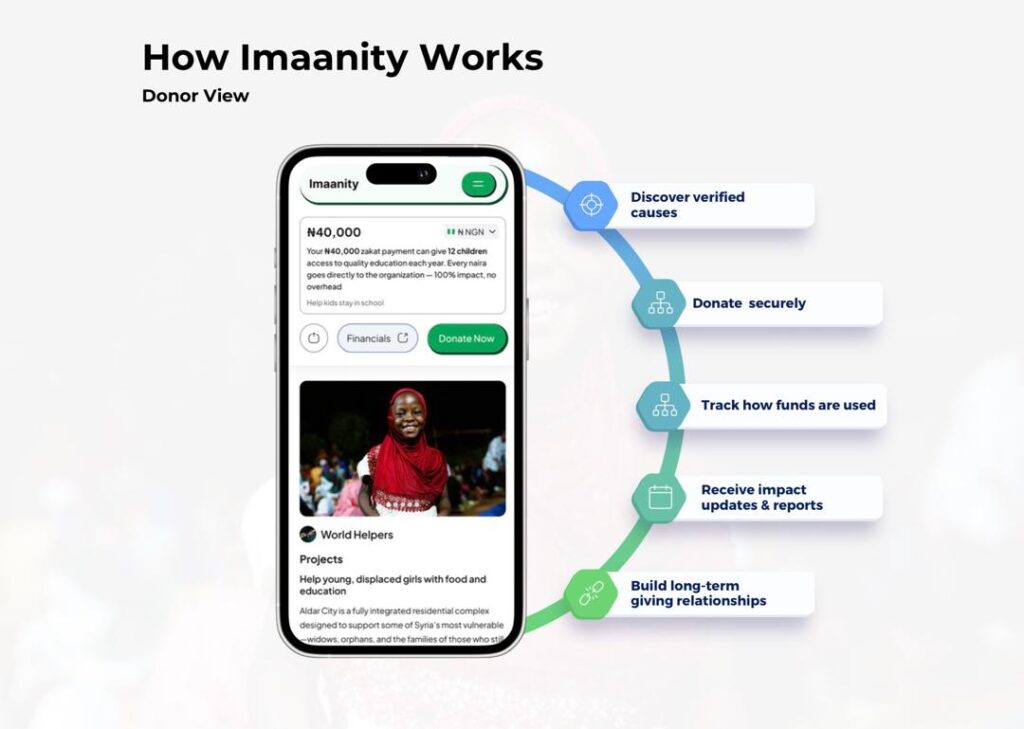
Inspired by both and meeting all the criteria above, Imaanity is an evidence-based giving platform built on the principle that donors deserve to know whether their giving is actually working.
- Imaanity independently assesses NGO partners on the ground in Nigeria across the categories where need is most acute: poverty relief, healthcare, education, clean water, emergency response, and support for women, children, and families.
- Its digital system delivers allows donors to trace their giving from donation to delivery.
- It offers verified outcomes, not mere stories and anecdotes, as well as ongoing visibility over time.
- They cover operational costs independently. This way, they ensure that 100% of donated funds reach their partner organisations.
- They provide faith-aligned giving options like tithes and zakat. Imaanity.com’s digital Zakat calculator covers everything from liquid cash to illiquid assets to help you arrive at your precise obligation without guesswork or omission.
- They provide seamless and convenient payment options.
- Donors can direct their contributions to specific geographical locations of their choice instead of just dump them into undifferentiated pools.
- Donors can also track the impact of their giving in real time.
Visit imaanity.com to get started today.
FAQs
What is Zakat? Zakat is one of the five pillars of Islam. It is an obligatory annual almsgiving of 2.5% of qualifying wealth, paid by eligible Muslims to support those in need.
Why is Zakat paid? It purifies wealth and redistributes resources within the Muslim community.
Who is required to pay Zakat? Any sane, adult Muslim who is debt-free (or whose assets exceed immediate debts) and has possessed wealth above the nisab threshold for one complete lunar year.
How do I calculate my Zakat? Use Imaanity.com digital Zakat calculator.
What assets are zakatable? Cash, savings, investment accounts, gold and silver, business inventory and cash, stocks and shares, and investment properties (excluding your primary residence).
What debts can I deduct? Debts due within the next 12 months, up to 12 months of instalments on longer-term debts, and arrears. You cannot deduct bills not yet due, interest payments, or long-term debt amounts not currently due.
When should I pay Zakat? Zakat becomes due after one complete lunar year of holding wealth above the nisab. Many Muslims choose Ramadan for the extra blessings, but you may pay whenever your personal Zakat year ends.
What is Zakat al-Fitr, and is it different from regular Zakat? Yes. Zakat al-Fitr (Fitrana) is a separate obligation paid during Ramadan before Eid prayers. It is due on every household member regardless of age or wealth and equals the cost of one meal per person.
Where can I pay Zakat in Nigeria? Options include local mosques, Islamic societies like Al-Habibiyyah Islamic Society and MPAC Nigeria, state Zakat boards, and online platforms such as Imaanity, Islamic Relief Worldwide, Muslim Aid, Zakat Foundation of America, and LaunchGood.
Who are the eight eligible Zakat recipients? As specified in Surah At-Tawbah (9:60): the poor, the needy, Zakat administrators, those whose hearts are to be reconciled, those in bondage, those in debt, those striving in the cause of Allah, and wayfarers.
Important Disclaimer
This guide provides general information about Zakat payment in Nigeria. For personal religious guidance, be sure to consult qualified Islamic scholars. For specific organizational information, we recommend you verify current programs and policies directly with each institution before making a donation.