Imaanity is bringing evidence-based giving and effective altruism to a new generation of African givers.

How the Internet Changed Generosity Forever
For most of modern history, charitable giving was organized around institutional trust. You gave to your church, your mosque, a reputable charity organization, or a government-backed charity. There was an unstated contract that the institution would decide where your money went and how it was used. Your role as a donor was largely passive: just give and trust.
In all honesty, that model produced real good in the world. It, however, produced enormous inefficiency, opacity, and in some cases, outright abuse. The information asymmetry between institutions and donors was so steep that most people had no practical way to know what happened to their money after it left their hands.
The internet collapsed that asymmetry. Suddenly, a donor anywhere could research an organization’s financials, read their field reports, cross-reference their impact claims, and compare the causes they serve. And with a level of rigour that was previously available only to major foundations that were supported by research teams. This caused a change in the expectations of donors. Giving became something one could think about and actively participate in, not just do.
How Gen Z and Millennials Are Giving
The generational data on giving is instructive, though it tends to be misread. The common narrative portrays millennials and Gen Z as reluctant or disengaged donors. The evidence says otherwise.
According to research, between 2021 and 2024, every generation increased its average household charitable giving. However, the internal distribution of that growth is telling. Boomers led in absolute terms, averaging $3,256 in 2024, up 27% from 2021. But millennials, averaging $1,616, grew their giving by 22% over the same period. They now outgive Gen X, who average $1,371 despite being older and, on average, further along in their earning years. Gen Z, the youngest cohort and the lowest earners, averaged $867 in 2024. This was at a 16% growth rate that exceeded Gen X’s 12%. When evaluated not by absolute dollar amount but by trajectory and income context, the younger generations are not lagging. They are accelerating.
Millennials And Gen Z Are Now Giving Mostly Online
The mechanism and motivation of that giving, however, diverge sharply from older patterns. More than 80% of millennials now make online gifts of some kind, compared to 58% of boomers, and over half of millennials give specifically through charity websites via smartphone. The most common trigger for online giving across all generations is something the donor encountered on a charity’s website, which underscores that digital presence and content quality are no longer secondary concerns for organizations seeking donations. They are primary ones. Where the generational split becomes most consequential is in institutional trust.
A 2022 study by Independent Sector found that 57% of Gen Z believe that giving directly through platforms like GoFundMe and mutual aid networks produces more impact than donating through traditional nonprofits. A Gallup and Walton Family Foundation study corroborated the broader pattern, finding that Gen Z’s scepticism extends across the full spectrum of American institutions, with philanthropy itself not exempt. This tracks with a well-documented decline in political engagement among the same cohort: just 42% of Americans aged 18 to 29 voted in 2024, down from 53% in 2020.
Giving As Participation
The interpretation that matters here is not that young people are disengaged. It is that they have recalibrated where they believe action is possible and effective. This has produced a measurable behavioural shift. Next-generation donors, defined as millennials and Gen Z collectively, are four times as likely as older donors to learn about a cause through an influencer or celebrity, and three times more likely to engage in active advocacy for an organization rather than passive financial support. Twenty percent of Gen Z report formal volunteering. The giving posture of this cohort is not purely transactional. It is, above all, participatory, and it demands a level of transparency and the demonstration of impact that older institutional models were not built to provide.
The instinct in the new generation of donors is to see the face behind the cause and skip the middleman. This is by no means unreasonable. But direct giving without rigorous vetting is not the same as effective giving. It can mean your money reaches someone in genuine need. Or it can mean it disappears into a poorly run operation or an outright scam. The scepticism that motivates the question “where does my money really go?” is healthy. The infrastructure to answer it well has, until recently, been largely absent.
Effective Altruism In Practice
Effective altruism is a body of thought that emerged from academic philosophy, primarily at Oxford University. It has since drawn a global community of practitioners. It is a philosophical response to the evolution in our giving behaviours that have been shaped by the internet. Its central argument is both straightforward and demanding: if you are going to help, you have a moral obligation to help as effectively as you can.
This sounds obvious. But in practice, it goes against most of how giving actually works.
Research consistently shows that charities that address similar problems may still produce outcomes per dollar spent that are vastly different. For example, GiveWell, one of the leading charity evaluators, has documented cases where some interventions were able to save a human life for roughly $5,500. Similar funds that were directed elsewhere produced almost no measurable impact. The difference is not passion or intention but structure, evidence and accountability. Effective altruism asks donors to internalize this fact and respond to it seriously.
The Underlying Principles of Effective Altruism
Effective altruism prioritizes scale: a cause that affects millions of people deserves more weight than one that affects thousands, all else being equal. Also demanded is impartiality: the geographic or cultural proximity of a cause to the donor should not automatically determine its priority. It cultivates what practitioners call a scout mindset, or a genuine willingness to update one’s beliefs in response to evidence rather than defending the causes that one already supports. And it requires an honest reckoning with tradeoffs. In other words, every choice to fund one intervention is a choice not to fund another, and pretending otherwise does not make the tradeoff disappear.
For African donors, whether giving from a tradition of Islamic zakat and sadaqah or Christian tithing and offering, this framework is not entirely strange. The theological grounding of giving across both traditions can no longer be seen as just compliance with a religious obligation. It must be accompanied by the conviction that a portion of one’s resources belongs to those who have less. Effective altruism does not replace that conviction. It takes it seriously enough to ask: if giving is an act of moral and spiritual weight, should it not be directed where it produces the most good?
The gap between generous intention and genuine impact is where enormous amounts of money are lost every year. Closing that gap is a technical problem as well as an intellectual and moral one.
What Imaanity Is Built to Do
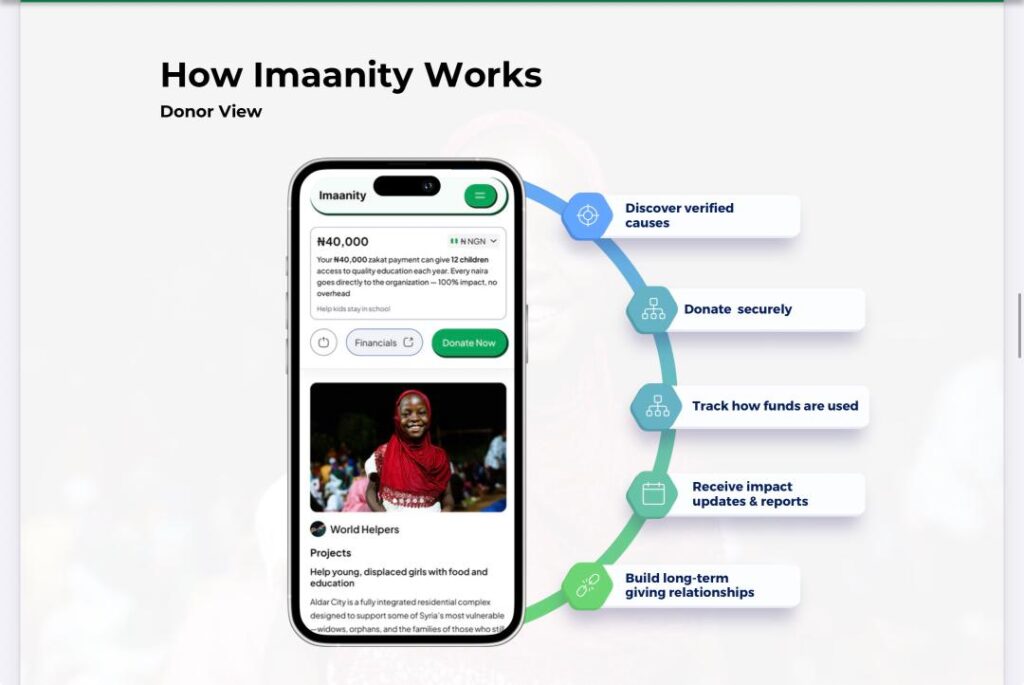
Imaanity enters this landscape not primarily as a fundraising platform but as what might best be described as a due diligence layer for philanthropic giving.
- Imaanity independently assesses NGO partners on the ground in Nigeria across the categories where need is most acute: poverty relief, healthcare, education, clean water, emergency response, and support for women, children, and families.
- Its digital system delivers allows donors to trace their giving from donation to delivery.
- It offers verified outcomes, not mere stories and anecdotes, as well as ongoing visibility over time.
- They cover operational costs independently. This way, they ensure that 100% of donated funds reach their partner organisations.
- They provide faith-aligned giving options like tithes and zakat. Imaanity.com’s digital Zakat calculator covers everything from liquid cash to illiquid assets to help you arrive at your precise obligation without guesswork or omission.
- They provide seamless and convenient payment options.
- Donors can direct their contributions to specific geographical locations of their choice instead of just dump them into undifferentiated pools.
- Donors can also track the impact of their giving in real time.
Visit imaanity.com to get started today.