The Islamic tradition contains one of the most developed frameworks for wealth, generosity, and ethical investment that any faith tradition has produced.
The Islamic Approach to Wealth
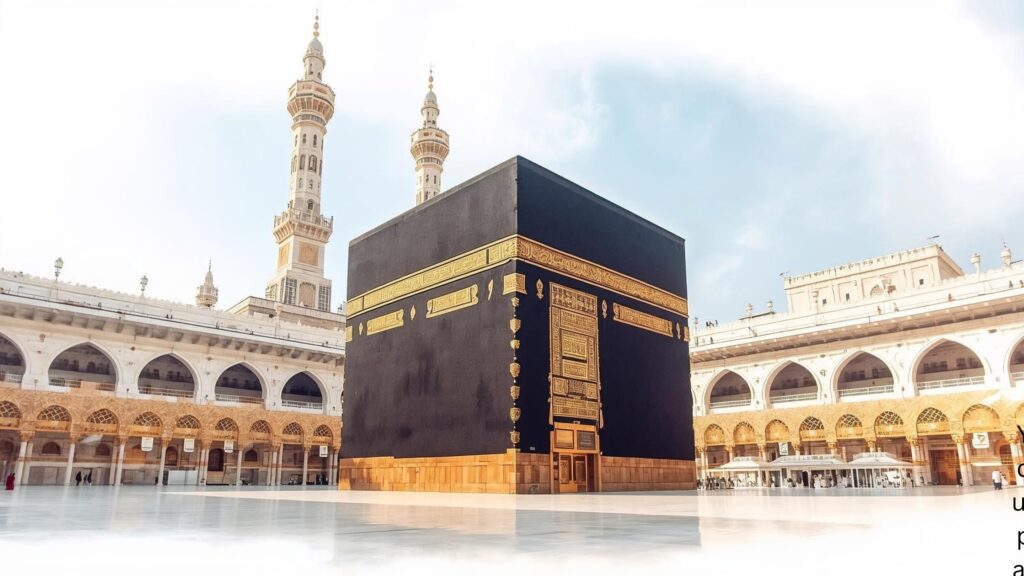
Islam does not regard wealth as something bad or deserving suspicion. Quite the contrary: it sees prosperity as a trust from God, to be earned through legitimate means and managed with care for the wider community. What Islam does prohibit is the accumulation of wealth at the expense of others, whether through exploitation, deception, or the extraction of interest (riba) from those who borrow.
This is the foundation of Shariah-compliant investing. Also known as halal investing, it is a growing global practice that applies Islamic ethical principles to financial markets. Shariah-compliant investment funds screen out companies that are involved in alcohol, pork products, gambling, pornography, weapons manufacturing, and conventional interest-based financial services.
They also avoid companies with excessive debt, as interest-bearing leverage contradicts Islamic financial principles. Therefore, where a portfolio company does generate a small portion of prohibited income, that portion must be calculated and donated to charity in a process known as purification. The result is an investment approach that looks, in practice, like the modern-day ESG (environmental, social, and governance) investing movement. Though its roots are much older.
The concept of Shariah-compliant funds dates to the late 1960s. The global Islamic funds market has since grown by more than 300% over the past decade. Today, nearly $200 billion is under management in Shariah-compliant investment vehicles globally, and the global halal economy is projected to reach $7.7 trillion by 2025. In Nigeria, demand has been strong enough that the Federal Government’s Sukuk bonds, its sovereign Islamic financial instruments, have been significantly oversubscribed by investors.
Core Principles of Shariah-Compliant Investing
At the heart of Halal mutual funds lie several fundamental principles that distinguish them from conventional investment products:
Prohibited Investments: Shariah-compliant funds strictly avoid investments in companies that are involved in alcohol production and distribution, pork products, gambling, pornography, weapons manufacturing and conventional interest-based financial services. This exclusionary screening ensures that your investment capital doesn’t support industries that contradict Islamic values or broader ethical standards.
Interest-Free Operations: Since Islam prohibits riba (interest), these funds cannot invest in conventional bonds or companies with excessive debt levels. Instead, they focus on equity investments and profit-sharing arrangements that align with Islamic financial principles.
Ethical Business Practices: Beyond industry exclusions, Shariah-compliant funds also evaluate whether companies engage in ethical business practices. This includes examining corporate governance, labour practices and environmental responsibility.
Purification Process: If a portfolio company does generate a small portion of income from prohibited activities, that income must be calculated and donated to charity to ‘purify’ the returns for investors. This ensures complete compliance with Islamic law.
What Islam Teaches About Giving
Beyond investment, Islam has built an entire architecture of obligatory and voluntary giving.
Zakat
Zakat is the most well-known. One of the Five Pillars of Islam, zakat is a mandatory annual contribution. It is calculated as a fixed proportion of all wealth held above a minimum threshold known as the nisab. Zakat is not a tax in the conventional sense, but an act of worship and a mechanism for purifying one’s wealth by acknowledging that a portion belongs to those with less. It is to be spent on specific categories of recipients defined by the Quran, including the poor, the indebted, and those working to collect and distribute zakat itself.
Sadaqah
Sadaqh is broader and more varied. Unlike Zakat, it is voluntary, and performed as an act of kindness toward others rooted in compassion rather than obligation. In Islamic tradition, Sadaqah is not limited to money. Spreading knowledge, giving good advice, sharing food, helping someone carry a load, even smiling at a fellow Muslim: all of these are considered acts of Sadaqah. This expansive definition reflects an understanding that generosity is a disposition, not merely a transaction.
Within Sadaqah, scholars distinguish between Sadaqah Wajibah (binding charity, which includes obligations like Sadaqatul Fitr at the end of Ramadan) and Sadaqah Nafilah (optional charity, which includes general philanthropy and giving to remove hardship).
Perhaps the most compelling concept is Sadaqah Jariyah. This is a charity whose benefits continue long after the original act. Providing clean water, sponsoring an orphan, planting trees, building a school or hospital, funding education: these are all acts of Sadaqah Jariyah, because they generate ongoing benefit for people who may never know the donor’s name. The Islamic tradition teaches that the rewards for such acts continue even after death, accruing to the giver for as long as the good they caused persists in the world.
The tradition of caring for orphans deserves particular mention. Allah mentions orphans in the Quran at least twenty-five times. The Prophet Muhammad (peace be upon him) said: “The one who cares for an orphan, and myself will be together in Paradise like this” — holding two fingers together to illustrate their closeness. Today, more than 153 million children worldwide are orphans, with 23 million having lost both parents. The Quranic emphasis on their care is not historical sentiment. It is a live obligation.
Waqf
This is the Islamic endowment. It extends the logic of Sadaqah Jariyah into an institutional form. Under waqf, a person dedicates land, property, or money to a permanent charitable purpose: a mosque, a school, a road, a soup kitchen. The asset is removed from private circulation and its benefits are directed to the community in perpetuity. Historically, waqf institutions funded hospitals, universities, and public infrastructure across the Muslim world. Modern waqf vehicles are being revived as sustainable mechanisms for community development.
The Challenge of Knowing Whether Your Money Works
All of this tradition rests on an assumption: that the giving produces genuine benefit. But for most of history, donors had no practical way to verify this. You gave to your mosque, your local charity, or a trusted institution. And you hoped for the best. The information asymmetry between institutions and donors was enormous, and it produced not just inefficiency but, in some cases, outright misuse.
The internet changed this. For the first time, donors could research an organisation’s financials, read field reports, cross-reference impact claims against independent evaluators, and compare approaches to the same problem — all from a smartphone. This created a fundamental shift in donor expectations, particularly among younger generations.
What the Change Looks Like
The generational data is striking. Between 2021 and 2024, every generation of American donors increased its charitable giving, but the patterns of growth reveal something important. Boomers led in absolute terms, averaging $3,256 in 2024.
But millennials, averaging $1,616, grew their giving by 22% over the same period, and they now outgive Gen X, who average $1,371 despite being older and further along in their earning years. Gen Z, the youngest and lowest-earning cohort, averaged $867 in 2024, growing at a rate that exceeded Gen X’s. When evaluated not by raw dollar figures but by trajectory and income context, the younger generations are not lagging. They are accelerating and giving differently.
More than 80%of millennials now make online charitable contributions, compared to 58% of boomers. Over half give specifically through charity websites via smartphone. More consequentially, a 2022 study by Independent Sector found that 57% of Gen Z believe that giving through platforms like GoFundMe produces more impact than donating to traditional nonprofits. This is by no means cynicism. It is a rational response to the collapse of institutional trust and the availability of tools that allow donors to investigate rather than simply believe.
Evidence-Based Giving
This shift has created the conditions for a more rigorous approach to philanthropy: evidence-based giving. The core idea is straightforward but demanding. It asks donors to look beyond a charity’s intentions and toward its measurable outcomes. For instance, do not ask how many textbooks were distributed, but whether the children who received them learned to read faster. Do not ask how many meals were served, but whether nutrition improved.
The gold standard is the randomised controlled trial (RCT), borrowed from medicine. An organisation randomly selects which communities receive its intervention and which serve as the comparison group, then measures the difference. When done rigorously, minimum 100 participants per group, running for at least 12 months, this method can establish whether a programme caused an improvement, rather than merely coinciding with one.
GiveDirectly
The most cited example is GiveDirectly’s programme in Kenya. GiveDirectly’s programme challenged the dominant assumption that poor people needed goods and services rather than cash. Their RCT tracked 500 households across 120 villages. It found that direct cash payments increased household assets by 58%and income by 34% over one year. A follow-up study found that children in recipient households earned 13% more as adults than those in comparison households. The programme didn’t just relieve short-term hardship. It changed life trajectories.
GiveWell
GiveWell, a leading charity evaluator, has documented cases where some interventions save a human life for roughly $5,500. In other instances, similar funds directed elsewhere produced almost no measurable impact. The difference is not passion or intention. It is structure, evidence, and accountability.
This is the intellectual foundation of effective altruism. It argues that if you are going to help, you have a moral obligation to help as effectively as you can. For donors rooted in Islamic tradition this framework is not foreign. It takes the theological conviction that giving matters seriously enough to ask: are we directing our generosity where it produces the most good?
Where Imaanity Is Built to Do
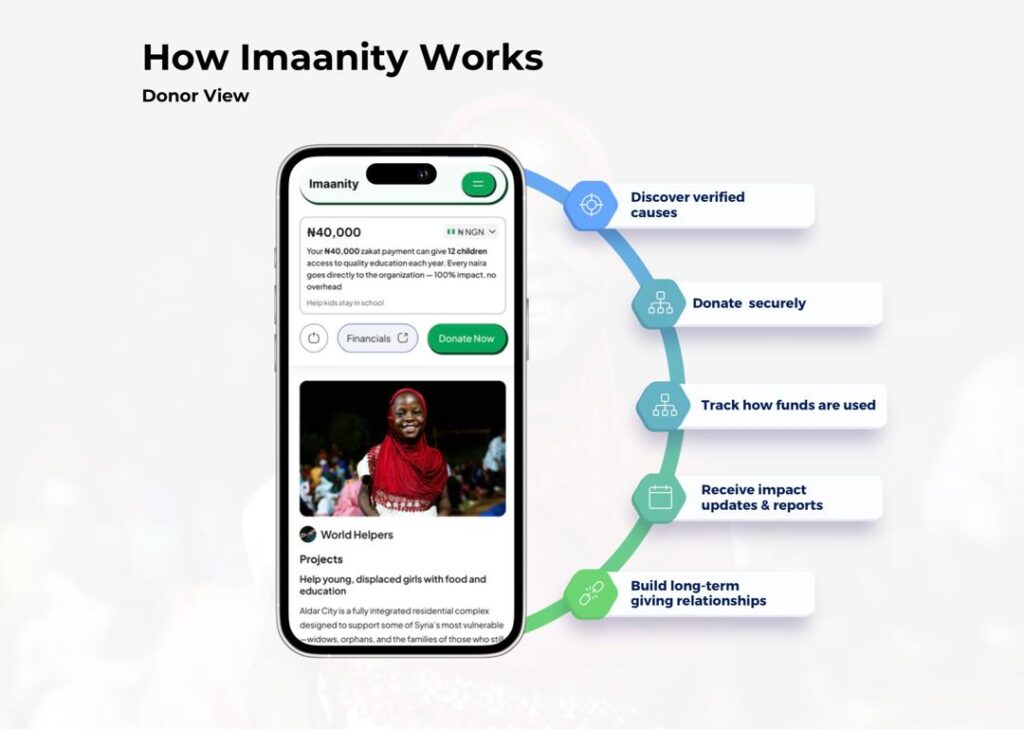
Imaanity enters this landscape not primarily as a fundraising platform but as what might best be described as a due diligence layer for philanthropic giving.
- Imaanity independently assesses NGO partners on the ground in Nigeria across the categories where need is most acute: poverty relief, healthcare, education, clean water, emergency response, and support for women, children, and families.
- Its digital system delivers allows donors to trace their giving from donation to delivery.
- It offers verified outcomes, not mere stories and anecdotes, as well as ongoing visibility over time.
- They cover operational costs independently. This way, they ensure that 100% of donated funds reach their partner organisations.
- They provide faith-aligned giving options like tithes and zakat. Imaanity.com’s digital Zakat calculator covers everything from liquid cash to illiquid assets to help you arrive at your precise obligation without guesswork or omission.
- They provide seamless and convenient payment options.
- Donors can direct their contributions to specific geographical locations of their choice instead of just dump them into undifferentiated pools.
- Donors can also track the impact of their giving in real time.
Visit imaanity.com to get started today.