Imaanity plans to lift one million lives across Africa by 2030 by providing an infrastructure supporting evidence-based giving.

What Is Evidence-Based Giving?
The answer to the question is in the name.
Evidence-based giving is directing one’s charities toward interventions that have demonstrated using rigorous data that they produce the outcomes they claim to produce for the causes they claim to support. The keyword here is demonstrated. Not promised, not plausible, not emotionally compelling but demonstrated.
This matters because the distance between a charity’s intention and its actual impact is often wider than donors know. An organisation can be sincerely motivated, competently managed, and genuinely popular with its beneficiaries. But yet fail to produce meaningful change in the specific metrics that matter.
Without a way to measure these metrics, this failure is invisible. The donor sees a compelling story and the annual report shows numbers that look like progress. But the underlying question for the organizations which is: whether the people served actually end up better off because of what we did, and not for some other reason, goes unanswered.
Evidence-based giving insists on that answer.
It asks donors to look beyond outputs and toward outcomes. For instance, instead of asking how many textbooks were distributed, donors should ask instead: did children who received those textbooks learn to read faster? Did the intervention cause the change, or would the change have happened anyway? These are harder questions, and for a long time, the sector was not built to answer them. The information donors needed simply did not exist in an accessible form.
Technology changed that.
How Data Transformed Our Giving Behaviours
Between 2021 and 2024, every generation of American donors increased its average household charitable giving. Boomers led in absolute terms, averaging $3,256 in 2024, a 27% increase over that period. But millennials, averaging $1,616, grew their giving by 22% over the same span and now outgive Gen X, who average $1,371 despite being older and, on average, further along in their earning years. Gen Z, the youngest and lowest-earning cohort, averaged $867 in 2024 at a 16% growth rate that exceeded Gen X’s 12%.
The New Generation of Givers is Seeking Transparency and Participation
When evaluated not by raw dollar amount but by trajectory and income context, younger donors are not lagging. Rather, they are accelerating. What is shifting is not just how much people give but how they give and why. More than 80% of millennials now make online gifts, compared to 58% of boomers. Over half of millennials give specifically through charity websites via smartphone. The most common trigger for online giving across all age groups is something the donor encountered on a charity’s website. This means digital transparency has moved from a nice feature to a core fundraising variable. Organisations that do not show their work online are effectively invisible to the fastest-growing segment of the donor population.
The more consequential shift is in institutional trust. A 2022 study by Independent Sector found that 57% of Gen Z believe that giving directly through platforms like GoFundMe and mutual aid networks produces more impact than donating through traditional nonprofits.
All this are evidence that the younger generation have recalibrated their beliefs about where effective action is possible. And they have done so in direct response to information that is now available to them. A donor who once had no choice but to trust an institution can now read its Form 990. They can now cross-reference its claims against independent evaluators, and compare the cost-effectiveness of its programmes against competing approaches to the same problem.
RCT: How Organisations Are Building Around Evidence
The gold standard that the sector has converged on is the randomised controlled trial, or RCT. The logic is borrowed from medicine. To know whether a drug works, you give it to one group of patients and a placebo to another. You then measure the difference. The random assignment is what makes the comparison valid: if the two groups were selected randomly, then any difference in outcomes between them can be attributed to the intervention rather than to pre-existing differences between the groups.
Applied to charitable programming, an RCT might look like this. An organisation running a school nutrition programme randomly selects which schools will receive the intervention in the first year, and which will serve as the comparison group. It measures attendance, test scores, and health indicators in both groups at the start, during, and after the programme. The treated schools measures its improvement relative to the comparison schools. If the difference is large enough to be statistically meaningful, the organisation can say with confidence that the programme caused the improvement. Not the passing of time, not a good harvest, not a new government policy.
The bar for that confidence is not casual. Most credible RCTs require a minimum of 100 participants per group to achieve what statisticians call 80% statistical power. This means an 80% probability that the study will detect a real effect if one exists. Larger, more complex programmes require correspondingly larger samples. The studies typically run for at least 12 months. Many of the most important ones track participants for years or decades to capture long-term effects that short-term measurements would miss.
GiveDirectly
GiveDirectly’s programme in Kenya is the most cited example of what this methodology can produce, and it is worth examining in detail. For years, the dominant assumption in international development was that poor people needed goods and services rather than cash. The reasoning was that direct transfers would be spent irresponsibly. GiveDirectly challenged that assumption not with argument but with measurement. Their RCT tracked 500 households across 120 villages.
The results showed that direct cash payments increased household assets by 58% and income by 34% over one year. Recipients invested in livestock, improved their housing, reduced hunger, and reported better mental health outcomes. A follow-up study found that children in treated households earned 13% more as adults than children in untreated households. The programme did not simply produce short-term relief. It altered trajectories.
What makes GiveDirectly’s work significant beyond its own outcomes is what it proved about the methodology. The RCT validated one organisation’s approach. It overturned an assumption that had shaped billions of dollars of aid spending across decades.
The cost of running the study was a fraction of the resources that would have been spent, over the same period, perpetuating an approach that the evidence now showed was inferior. This is the return on investment in evidence that the charitable sector has been slow to account for: the cost of not knowing whether your programme works is paid continuously, in wasted resources and foregone impact, for as long as the ignorance persists.
RCT Is Not the Only Source of Evidence
It would be a mistake to treat the RCT as the only legitimate form of evidence, and the best practitioners in evidence-based philanthropy are careful to say so. Field experience like the practical knowledge accumulated by programme staff, community health workers, and beneficiaries themselves, answers questions that no trial design can capture.
Informed opinion, from policymakers, community leaders, and sector experts, provides the context that makes research results interpretable. A study might show that a nutrition programme produced no measurable improvement in a particular region, but a local programme manager might know that the distribution was disrupted by seasonal flooding and the comparison is therefore not valid.
The Center for High Impact Philanthropy describes these as three concentric circles of evidence: academic research, field experience, and informed opinion. The most credible philanthropic decisions draw on all three. The value of rigorous trials is not that they eliminate the need for other forms of knowledge. It is that they anchor the entire system in something verifiable. They produce a point of reference that prevents motivated reasoning and institutional self-interest from filling the space that data should occupy.
Imaanity: A Platform for Evidence-Based Giving
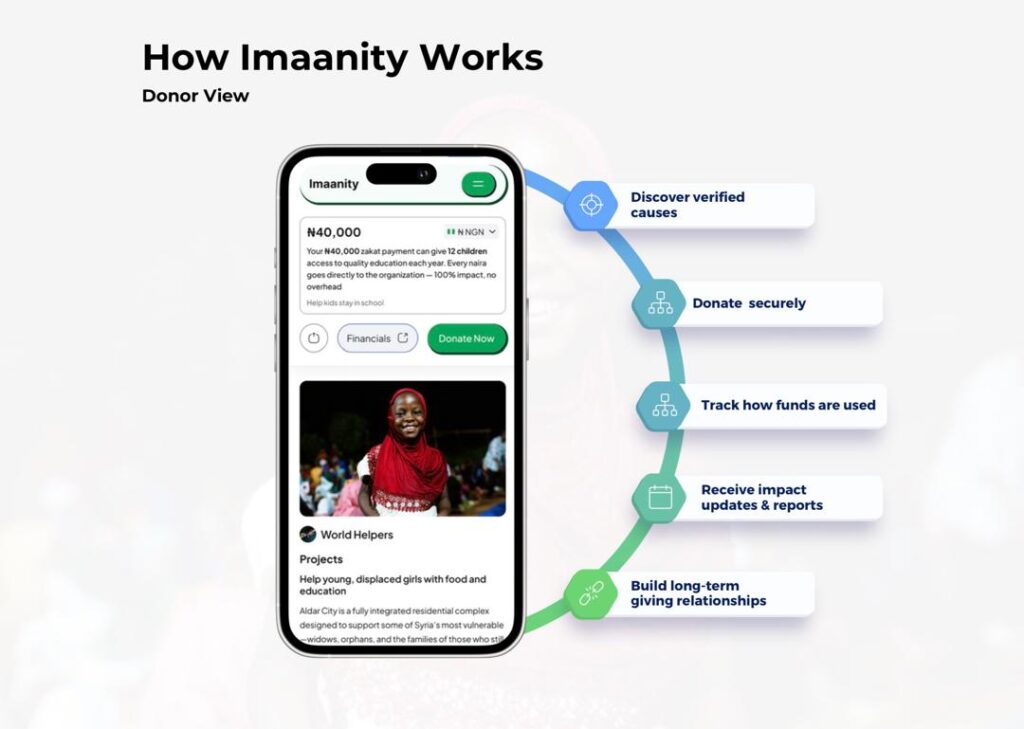
What donors are really asking for, when they ask for evidence, is infrastructure. This is precisely the gap that platforms like Imaanity are designed to close.
- Imaanity independently assesses NGO partners on the ground in Nigeria across the categories where need is most acute: poverty relief, healthcare, education, clean water, emergency response, and support for women, children, and families.
- Its digital system delivers allows donors to trace their giving from donation to delivery.
- It offers verified outcomes, not mere stories and anecdotes, as well as ongoing visibility over time.
- They cover operational costs independently. This way, they ensure that 100% of donated funds reach their partner organisations.
- They provide faith-aligned giving options like tithes and zakat. Imaanity.com’s digital Zakat calculator covers everything from liquid cash to illiquid assets to help you arrive at your precise obligation without guesswork or omission.
- They provide seamless and convenient payment options.
- Donors can direct their contributions to specific geographical locations of their choice instead of just dump them into undifferentiated pools.
- Donors can also track the impact of their giving in real time.
Visit imaanity.com to get started today.