This is the story of how traditional cash crops that defined Nigeria’s economic history have been quietly superseded by a new agricultural commodity: sesame seeds.

Deposing the Traditional Cash Crops
Before the discovery of crude oil transformed Nigeria’s economic landscape in the 1960s, the nation’s wealth flowed from the rich soils of its agricultural heartlands. Cocoa from the Western regions, groundnuts from the North and palm oil from the East formed the triumvirate of cash crops that defined Nigeria’s colonial and early post-independence economy. These commodities financed infrastructure development, funded education and sustained entire regions through cooperative societies and marketing boards.
The iconic groundnut pyramids of Kano, each storing up to 15,000 bags of nuts, symbolized an era when agriculture powered more than 50 % of GDP and 64.5 % of export revenue in the 1960s. The 26‑storey Cocoa House in Ibadan, built entirely from cocoa proceeds, was built as West Africa’s first skyscraper and still stands today as a physical monument to agrarian triumph
Yet, as oil revenues began to dominate Nigeria’s export portfolio, these traditional cash crops gradually faded from economic prominence. The Dutch disease effect saw agricultural investment decline, infrastructure deteriorate, and farming communities struggle to maintain their former glory. For decades, Nigeria’s agricultural sector contributed significantly to GDP. Agriculture still accounts for 22.35% of the country’s Gross Domestic Product as of 2021, but the export story seemed confined to the past.
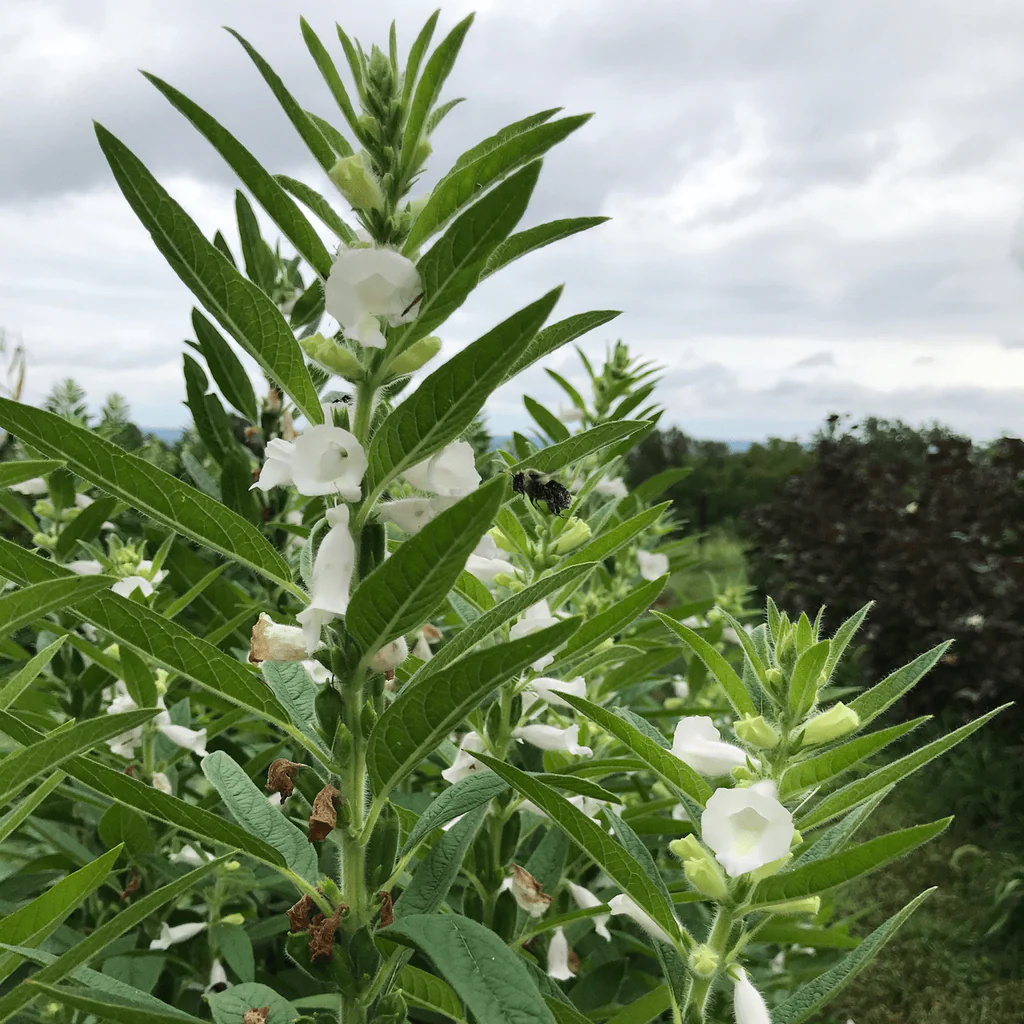
However, a small, drought-resistant sesame seeds, locally known as “benne seeds,” has been quietly rewriting Nigeria’s economic history. They have steadily grown into what has become the country’s leading agricultural export, surpassing even the once-mighty cocoa in international trade value.
The Quiet Rise of a Mighty Seed
The transformation has been remarkable. By 2024, sesame seeds had claimed the throne as Nigeria’s top agricultural export, with first quarter exports alone valued at ₦247.75 billion, a figure that represents a stunning 123% increase compared to the corresponding quarter of 2023. This represented a dramatic surge from the ₦124.5 billion exported in Q4 2023, which demonstrates the crop’s accelerating momentum.
The growth trajectory tells an even more compelling story when viewed over time. In 2018, sesame exports in the first quarter totalled ₦26.6 billion, an 83.1% increase from the ₦14.53 billion generated in Q4 2017 and a year-on-year growth of 104.1% from the ₦13.03 billion recorded in Q1 2017. By 2024, Nigeria was exporting ₦700 billion worth of sesame annually, according to the Nigerian Export Promotion Council. This meant that it contributed 1.3% to Nigeria’s exports in 2024. Coming behind sesame seeds were superior quality cocoa beans, with ₦230.85 billion and standard quality cocoa beans with ₦140.09 billion in export value.
Sesame seeds, however, remain in competition with cocoa.
By Q1 of 2025, however, cocoa beans and cashew had superseded it, thanks to a surge in prices that has been driving farming efforts across the country. It also lost this position in 2022 but regained momentum in 2023. Expert explanation for this has that sesame seeds currently being planted are agitated, with no recent update from research and development, hence the low yield in production.
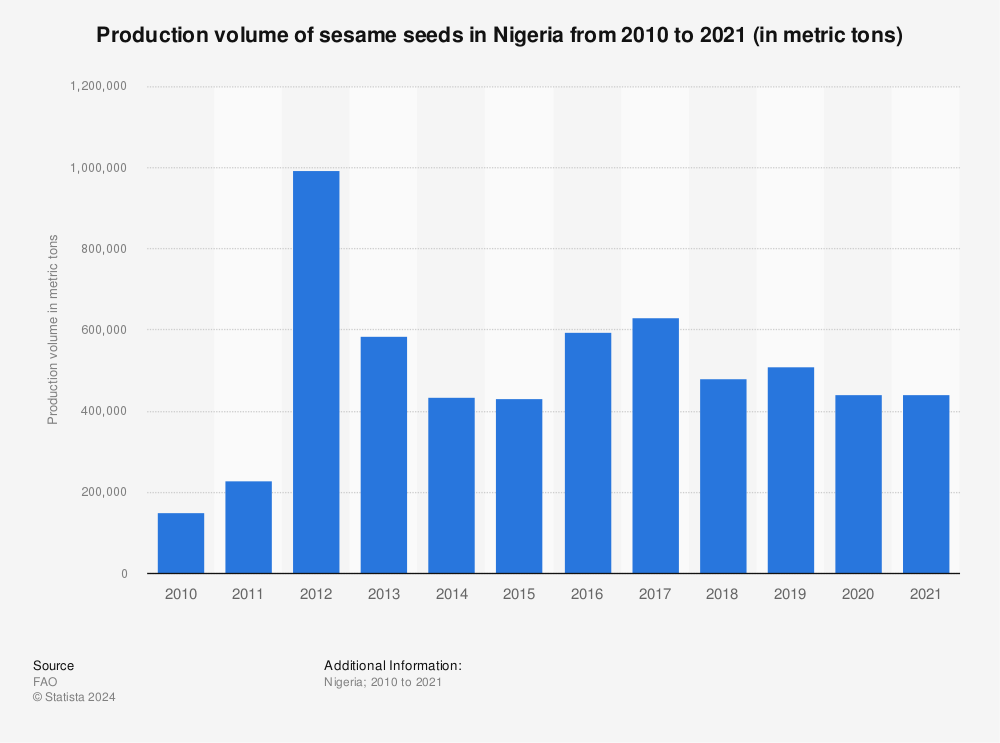
Nigeria’s ascent in the global sesame market has been equally impressive. The country now ranks as the second-largest sesame exporter in Africa, behind only Sudan, and holds the fourth position globally in production. With over 4.8 million tonnes produced worldwide annually, Nigeria contributes significantly to this total with an annual production of 450,000 metric tonnes as of 2017, and 509,712 metric tonnes by 2022.
The geographical concentration of sesame production tells its own story of agricultural adaptation. The crop thrives in Nigeria’s northern states including, Jigawa, Nasarawa, Benue, Sokoto, Yobe, Kano, Katsina, Kogi, Gombe, and Plateau. In these regions, traditional farming has had to adapt to increasingly challenging climatic conditions. In Jigawa State alone, over 6,000 registered farmers cultivate sesame primarily for export, with towns like Babura, Mallam-Madori, and Maigatari emerging as major production centres.
The Perfect Storm of Factors
Several converging factors explain sesame’s meteoric rise. First, the crop’s remarkable resilience makes it ideally suited to Nigeria’s changing agricultural environment. Unlike many traditional crops, sesame thrives in drought conditions where others fail. The crop requires minimal fertilizer input and demonstrates natural pest resistance. These qualities significantly reduce production costs for farmers.
The global demand dynamics have also been favourable. Countries like China and Japan have developed insatiable appetites for high-quality sesame oil, which contains no cholesterol and is considered superior to other vegetable oils. In the first quarter of 2018, China imported ₦8 billion worth of Nigerian sesame, while Japan purchased ₦6.56 billion worth, and Turkey imported ₦6.1 billion worth. By Q1 2024, these figures had grown substantially, with ₦83.29 billion worth of sesame exported to China and ₦58.04 billion to Japan.
The crop’s versatility adds to its appeal. Sesame seeds contain 50.5% oil and 25% protein, making them valuable for pharmaceuticals, confectionery, cosmetics, paints, soaps, lubricants and shampoos. This diverse application base ensures steady demand across multiple industries.
The economic incentives for farmers have been compelling. The crop provides better returns than many alternatives while requiring less investment in inputs. The fact that Nigeria exports 80% of its annual sesame production, demonstrates the strong international demand that is responsible for its growth.
The Market Players and Structure
The sesame export ecosystem in Nigeria is dominated by three major companies: Olam (an Indian multinational agribusiness), Kelani Ark Poter Hamlet Ltd and Greenwen International Resources. Other significant players include Errand Horse Ltd and Paveway International Traders Ltd. These companies work through a network of buyers and middlemen who travel to rural areas to purchase from subsistence farmers, then transport the seeds to major trading centres.
The urban markets in sesame-producing states serve as crucial collection points: Malam-Madori in Jigawa, Doma in Nasarawa, Potiskum in Yobe, and Dawanau in Kano State. This structure, while effective for aggregating production from the estimated 26 states where sesame is now cultivated, also highlights one of the sector’s limitations: the lack of value addition within Nigeria.
Currently, Nigeria only exports raw sesame seeds and does not extract oil at commercial scale, despite having contract cleaning facilities in Lagos. This represents a significant opportunity cost, as Dr. Hussain Ibrahim, Director-General of the Raw Materials Research and Development Council, noted, Nigeria has the potential to earn between $500 million and $1 billion annually with proper value addition.
Persistent Challenges
Despite its success, the sesame sector faces numerous obstacles that limit its full potential. Francis Unuafe, Managing Director of Errand Horse Nigeria Ltd, a sesame seed exporter, identified several critical challenges: difficulty in sourcing quality seeds that meet international standards, inadequate laboratory facilities for proper testing before export, and Nigeria’s poor international image which affects buyer confidence.
Infrastructure deficits compound these problems. Poor road networks frustrate the movement of seeds from rural production areas to laboratories and ports. The ineffective equipment and facilities at Apapa Port cause delays that result in exporters missing shipping schedules and incurring demurrage costs. Multiple taxation and inadequate crop processing plants further constrain the sector’s growth, as highlighted by Alhaji Sheriff Balogun.
Financial access remains another significant hurdle. While the Nigerian Export-Import Bank (NEXIM) provides facilities for exporters, many struggle to meet the bank’s requirements or face delays in loan processing. The bank requires genuine evidence of exportation and advises registration with the Nigerian Export Promotion Council (NEPC) to improve access to credit facilities.
Recent challenges have emerged around quality control. Dr. Jumoke Oduwole, Minister of Industry, Trade and Investment, noted that Japan, which represents 40% of Nigeria’s sesame exports, has experienced setbacks due to sanitary conditions of many products. This has prompted the launch of the STDF 845 project, a three-year initiative between the International Trade Centre and NEPC to enhance quality compliance and reduce export rejections.
The Economic Implications
The rise of sesame seeds as Nigeria’s leading agricultural export carries profound implications for the country’s economic future. With Nigeria’s population projected to reach 400 million by 2050, the success of drought-resistant, low-input crops like sesame offers a model for sustainable agricultural intensification.
The sesame story also demonstrates the potential for Nigeria’s agricultural sector to reclaim its position in international trade. According to figures released by the NEPC, Nigeria’s non-oil products exported in the first quarter of 2025 rose by 24.75 per cent to $1.791bn. This represents a 24.75% increase over the $1.436bn reported in the First Quarter of 2024. The list was dominated by agricultural products, with cocoa leading the way with 45.02% and cashew nuts, third with 5.81% of the total exported non-oil commodities.
The government’s recent initiatives, including the Agriculture Promotion Policy and various export promotion programs, signal recognition of agriculture’s strategic importance. However, the sesame experience shows that success requires addressing fundamental infrastructure and value-chain constraints. The quiet rise of sesame seeds from obscure “benne seeds” to Nigeria’s top agricultural export offers both inspiration and instruction. It demonstrates that with the right crop, market conditions, and farmer dedication, Nigeria can compete globally in agricultural markets. The challenge now is to build on this success by adding value, improving quality and expanding to other crops, to create a truly diversified and resilient agricultural export economy.
The Lesson
Perhaps most importantly, the sesame success story illustrates how Nigeria can leverage its agricultural advantages in the global marketplace. Nigeria’s position as the second-largest sesame exporter in Africa and fourth globally represents a foundation for broader agricultural export growth. Whether Nigeria can fully capitalize on this opportunity will depend on its ability to learn from the sesame success and apply those lessons across its vast agricultural potential. The foundation has been laid; now comes the critical work of building upon it.