For the first time in nearly two decades, Ramadan and Lent have arrived together. About 3.5 billion people worldwide will simultaneously observe fasting, prayer, reflection and giving. Such moments invite both Muslims and Christians to examine whether the generosity we show in this season is actually producing the change we intend.

Ramadan: A Season Built for Giving
During Ramadan, Muslims abstain from food in is essentially a total recalibration of the soul. The fast strips away the comfortable rhythms of ordinary life and creates, in their place, a heightened awareness of God, of community, and of the millions of people for whom hunger is not a spiritual discipline but a daily reality. Naturally, this awareness manifests itself in charity.
Zakat, one of the Five Pillars of Islam, is the obligatory giving of a portion of one’s accumulated wealth to those in need. It is not optional, and it is not metaphorical. It is a demand on the faithful to redistribute their wealth. And while Zakat can be given at any point in the year, the vast majority of Muslims choose to fulfil this obligation during Ramadan.
The spiritual logic behind this trend is compelling. Islamic tradition holds that good deeds during Ramadan carry multiplied reward, with the last ten nights of the month carrying particular weight. Laylatul Qadr, or the Night of Power, falls within this period, and the Quran describes it as “better than a thousand months” (Quran 97:3). To give on such a night is to plant a seed in the most fertile spiritual soil imaginable. Beyond Zakat, Ramadan also intensifies Sadaqah, a voluntary charity that goes beyond what is obligated. And then there is Sadaqah Jariyah, an ongoing charity whose benefits outlast the donor’s lifetime.
Research from the Muslim Philanthropy Initiative at Indiana University’s Lilly Family School of Philanthropy shows that Muslim-led organisations receive nearly 60% of their annual donations in the months surrounding Ramadan. In terms of charitable energy, it is one of the most concentrated giving seasons in global philanthropy.
Lent and Almsgiving as an Act of Emptying Oneself
Lent does not generate the same density of charitable data that Ramadan does. But its theological demand on the giver is no less serious. The forty days leading to Easter are structured around three pillars: prayer, fasting, and almsgiving. Of these, almsgiving is perhaps the least culturally visible. Yet, in many ways, it is the most demanding.
The word “alms” traces its roots to the Greek eleos, meaning mercy. To give alms, in the fullest Christian sense, is not simply to drop coins into a collection basket. It is to extend mercy: to give of one’s time, talent, and comfort, not just one’s money. The Catechism of the Catholic Church articulates it plainly: the goods of creation are destined for the entire human race, and giving to the poor is not merely an act of generosity but “a work of justice pleasing to God” (No. 2462).
Jesus’s own words in the Gospels set an uncomfortable standard. He does not commend giving from surplus. Instead, he commends the widow who gave everything she had. He instructs his followers to invite not their well-connected friends to dinner but the poor, the lame, and the blind, that is, those who cannot repay. The point of Lenten almsgiving, as theologians describe it, is to empty oneself in imitation of Christ, who “emptied himself, taking the form of a slave” (Philippians 2:7). Giving that costs nothing, changes nothing, in the giver or the recipient.
The Gap Between Intention and Impact
Here is where both traditions arrive at the same uncomfortable frontier.
Billions of dollars flow through the charitable sector every year. Most of it animated by genuine faith, real compassion, and deeply held obligation. And yet the development sector has accumulated decades of evidence showing that well-intentioned money frequently produces far less change than donors assume. An organisation can be sincerely motivated, professionally staffed, and deeply loved by its beneficiaries, and still fail to produce measurable improvement in the specific conditions it claims to address.
The problem is not bad faith, but the absence of rigorous measurement. Without it, donors see only compelling stories. They read annual reports full of numbers that look like progress. But the underlying question of whether the people served are actually better off because of the intervention, rather than for some other reason, goes unanswered.
Evidence-based giving insists on that answer.
It asks donors to look beyond outputs and toward outcomes. For instance, instead of asking how many textbooks were distributed, donors should ask instead: did children who received those textbooks learn to read faster? Did the intervention cause the change, or would the change have happened anyway? These are harder questions, and for a long time, the sector was not built to answer them. The information donors needed simply did not exist in an accessible form.
Sacred Obligation Meets Rigorous Evidence
Imaanity is built to close to precisely close this gap.
It is not primarily a fundraising platform. More accurately, it is inspired by effective altruism, a body of thought that was developed in response to the evolution in our giving behaviours, shaped by the desire for more data-driven, evidence-based giving. The central argument effective altruism of is: if you are going to help, you have a moral obligation to help as effectively as you can.
In keeping with this:
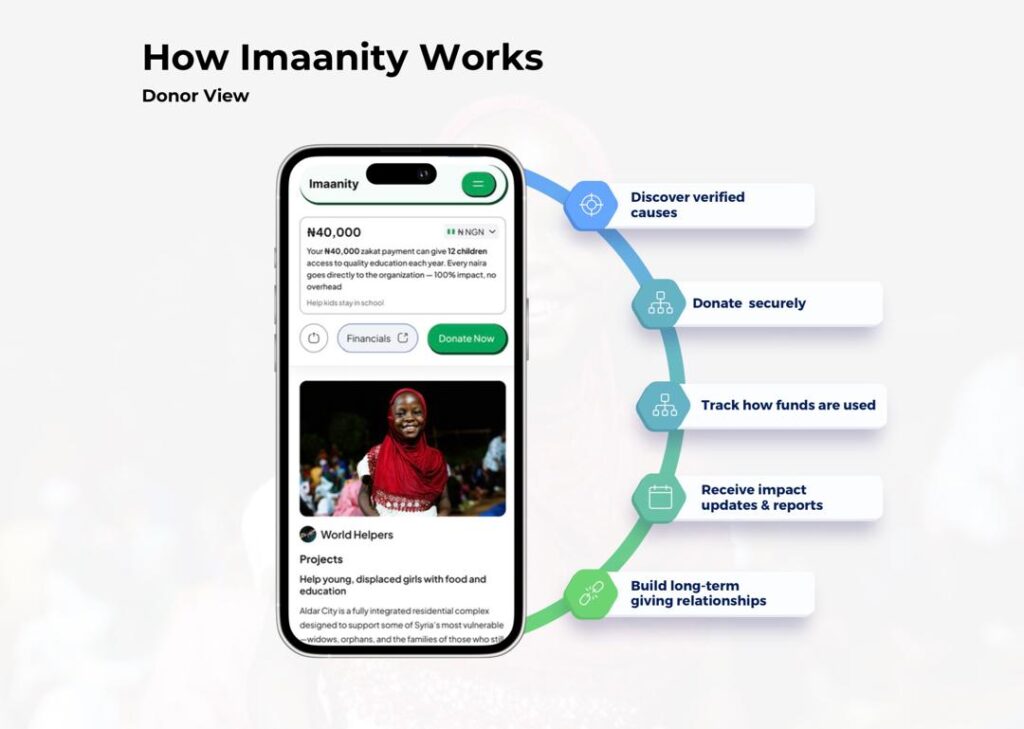
- Imaanity independently assesses NGO partners on the ground in Nigeria across the categories where need is most acute. Those areas include poverty relief, healthcare, education, clean water, emergency response, and support for women, children, and families.
- Its digital system delivers allows donors to trace their giving from donation to delivery.
- It offers verified outcomes, not mere stories and anecdotes, as well as ongoing visibility over time.
- They cover operational costs independently. This way, they ensure that 100% of donated funds reach their partner organisations.
- They provide faith-aligned giving options like tithes and zakat. Imaanity.com’s digital Zakat calculator covers everything from liquid cash to illiquid assets to help you arrive at your precise obligation without guesswork or omission.
- They provide seamless and convenient payment options.
- Donors can direct their contributions to specific geographical locations of their choice instead of just dump them into undifferentiated pools.
- Donors can also track the impact of their giving in real time.
Visit imaanity.com to get started.